Deutscher Rheumatologiekongress 2026
Orthopaedic surgical patterns in inflammatory rheumatic diseases in Germany: Nationwide hospitalisation trends and DRG-based procedure analysis
Text
Introduction: Inflammatory rheumatic diseases represent a major cause of morbidity and healthcare utilisation worldwide. Over recent decades, treatment strategies have substantially evolved, particularly with the introduction of biologic and targeted synthetic disease-modifying antirheumatic drugs. Despite advances in pharmacological therapy, progressive structural joint damage frequently requires orthopaedic surgical treatment. However, nationwide data describing long-term hospitalisation trends and orthopaedic procedure patterns across major inflammatory rheumatic diseases in Germany remain limited. The aim of this study was therefore to analyse nationwide hospitalisation trends and associated orthopaedic surgical procedures in major inflammatory rheumatic diseases.
Methods: This nationwide population-based study analysed aggregated inpatient hospital discharge data from the German Federal Health Monitoring system (GBE-Bund). Hospitalisations associated with rheumatoid arthritis (ICD-10-GM M05–M06), psoriatic arthritis (L40.5), ankylosing spondylitis (M45), juvenile arthritis (M08), and osteomyelitis (M86) were extracted for the period 2010–2023.
To assess surgical care patterns, orthopaedic procedures were analysed using the German Institute for the Hospital Remuneration System (InEK) DRG browser. Hospitalisations were identified using the respective ICD-10 codes as the principal diagnosis, and procedure frequencies were extracted based on corresponding OPS codes. For rheumatoid arthritis, codes M05.1x, M05.2x, M06.1, and M06.3 were excluded to avoid inclusion of distinct clinical entities not representing classical rheumatoid arthritis. DRG data correspond to version 2024 grouped according to the 2025 classification.
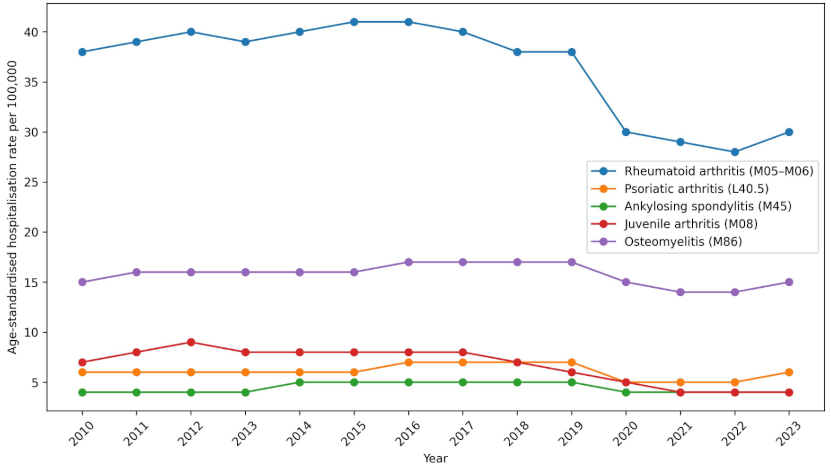
Results: Hospitalisation trends differed substantially between disease groups. Rheumatoid arthritis hospitalisations increased from 29,775 cases in 2010 to a peak of 32,755 in 2016, followed by a marked decline to 24,992 cases in 2023 (−24%). Juvenile arthritis hospitalisations showed a similar pattern, decreasing from 7,183 cases in 2012 to 3,521 in 2023 (−51%). In contrast, psoriatic arthritis hospitalisations increased moderately over time, while ankylosing spondylitis hospitalisations remained relatively stable across the study period. Osteomyelitis demonstrated a moderate increase between 2014 and 2019 followed by a decline in subsequent years.
Analysis of orthopaedic procedures demonstrated distinct disease-specific surgical patterns. Among hospitalised patients with rheumatoid arthritis (M05/M06), knee joint replacement (OPS 5-822; n = 121) and hip replacement (OPS 5-820; n = 51) represented the most frequent orthopaedic interventions. Psoriatic arthritis showed a similar but substantially lower procedural volume, including 11 knee and 6 hip replacements. In contrast, patients with ankylosing spondylitis (M45) predominantly underwent spine-related procedures, including spinal stabilisation and spondylodesis.
Conclusion: Over the past decade, hospitalisations for rheumatoid and juvenile arthritis have declined substantially in Germany, likely reflecting improved disease control with modern pharmacological therapies. Nevertheless, orthopaedic surgery remains an important component of disease management. Distinct surgical patterns across inflammatory rheumatic diseases highlight the different structural manifestations of these conditions and underline the continued relevance of specialised rheuma-orthopaedic care. As the DRG-based analysis primarily captures inpatient procedures, the increasing shift of orthopaedic interventions toward outpatient care should be considered when interpreting these findings.
Disclosures: None
Figure 1 [Fig. 1]
Figure 1: Age-standardised hospitalisation trends in major rheumatic disease in Germany