
German Congress of Orthopaedics and Traumatology 2026 (DKOU 2026)
Inhibition of AXL receptor tyrosine kinase enhances osteoblast function and bone mass in mice
Text
Objectives and questions: Osteoporosis is characterized by reduced bone formation and an increased risk of fracture. Current anabolic therapies are limited by safety concerns, high cost, and restricted treatment duration. Identifying small-molecule targetable regulators of osteoblast differentiation could enable new therapeutic strategies. Using a kinome-wide RNAi screen in primary murine calvarial osteoblasts, we identified the AXL receptor tyrosine kinase (Axl) as a negative regulator of osteoblast differentiation. Axl expression was highest in immature osteoblasts and declined with maturation. We hypothesized that genetic or pharmacological inhibition of Axl enhances osteoblast activity and bone formation in vitro and in vivo.
Material and methods: Primary murine osteoblasts isolated from neonatal calvariae and adult long bones were subjected to siRNA-mediated Axl knockdown or treated with the selective Axl inhibitor BGB324. Osteoblast differentiation was assessed by alkaline phosphatase (Alp) activity, osteogenic gene expression, and matrix mineralization. Adult female BALB/c mice received oral BGB324 or vehicle for two weeks. Bone architecture was analyzed by high-resolution microcomputed tomography (µCT), while static and dynamic histomorphometry assessed bone formation parameters. Plasma bone turnover markers were measured by ELISA. Transcriptomic changes following Axl knockdown were analyzed by RNA sequencing and functionally validated.
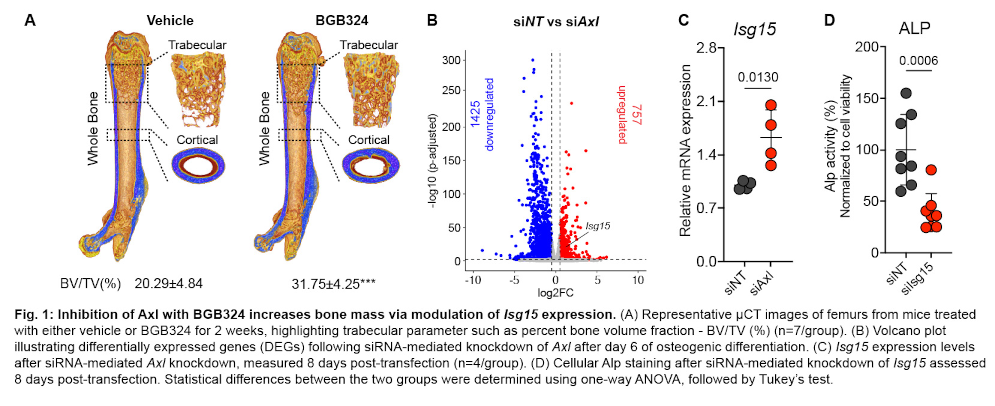
Results: The RNAi screen identified Axl as a potent suppressor of osteoblast differentiation. In vitro, Axl knockdown markedly increased Alp activity (+398%±135), upregulated Runx2, Sp7, and Alpl, and enhanced matrix mineralization (+459%±116). Treatment with BGB324 increased Alp activity (+47%±24) and mineralization (+165%±111). In vivo, µCT revealed increased trabecular bone volume fraction (BV/TV) in femora (Figure 1A [Fig. 1]) and vertebrae (+29%±3), driven by higher trabecular thickness and number, with no changes in cortical thickness. Dynamic histomorphometry showed increased mineralizing surface, mineral apposition rate and bone formation rate (BFR: +206%±60). Static histomorphometry demonstrated reduced osteoblast surface (Ob.S/BS, −57%±1), but increased osteocyte density (+21%±137), suggesting accelerated osteoblast-to-osteocyte transition. Plasma PINP levels were elevated (+33%±0.8), while CTX-I remained unchanged, indicating a purely anabolic effect. RNA sequencing identified interferon-stimulated gene 15 (Isg15) as a key downstream effector (Figure 1B,C [Fig. 1]). Isg15 knockdown reduced Alp activity (Figure 1D [Fig. 1]), mineralization (−92%±6), and Erk1/2 phosphorylation, positioning Isg15 as a key downstream effector of Axl signaling in osteoblasts.
Discussion and conclusions: Axl suppresses osteoblast differentiation and bone formation via an Isg15-Erk signaling axis. Pharmacological Axl inhibition enhances trabecular bone formation without affecting bone resorption, identifying Axl asa promising osteoanabolic target and supporting the repurposing of BGB324 for osteoporosis and impaired skeletal regeneration.



