
German Congress of Orthopaedics and Traumatology 2026 (DKOU 2026)
Increased ROS levels impair osteoblast differentiation via TLL1 in human MSCs
Text
Objectives and questions: Osteoporosis (OP) is characterized by low bone mass and impaired bone microarchitecture, resulting in an increased fracture risk. Oxidative stress is a critical contributor to OP pathogenesis. We previously showed that mice with an osteoblast lineage-specific superoxide dismutase 2 (Sod2)knockout and elevated reactive oxygen species (ROS) levels exhibit an age-related OP-like phenotype. The aim of this study was to investigate how increased ROS levels caused by SOD2 depletion affect osteoblast differentiation and its molecular regulation in human mesenchymal stem cells (hMSCs).
Material and methods: hMSCs were transfected with siRNA targeting SOD2 (siSOD2) or a non-targeting control siRNA (siNT), and subjected to osteogenic induction. Cells were harvested on days 6 and 12 for gene expression analysis (qPCR) and ROS quantification (dihydroethidium assay), or on day 6 for protein expression analysis (western blot) and RNA sequencing (RNAseq). To investigate molecular mechanisms linked to SOD2 deficiency, hMSCs were transfected with siRNA targeting Tolloid Like 1 (TLL1) or siNTand cultured under osteogenic induction conditions for 6 days. Cell viability (PrestoBlue assay) and qualitative and quantitative alkaline phosphatase (ALP) activity were analyzed. Statistical analyses were performed using an unpaired two-tailed Student’st-test.
Results: Efficient SOD2 knockdown significantly increased ROS levels in hMSCs (Figure 1A,B [Fig. 1]), resulting in impaired osteogenic differentiation, as indicated by reduced expression of osteoblast-specific marker genes, particularly at later stages (Figure 1C,D [Fig. 1]). Concomitantly, senescence- and adipogenesis-associated marker genes were increased (Figure 1E,F [Fig. 1]). Furthermore, SOD2 knockdown significantly reduced NF-κB protein levels (1.0±0.06 vs 0.57±0.103, P ≤0.001). RNAseq analysis identified 291 downregulated and 177 upregulated genes (log2FC ≥ 1.0 or ≤ -1.0, adjusted p <0.01) followingSOD2 silencing (Figure 1G [Fig. 1]). Pathway enrichment analysis revealed the extracellular matrix-related NABA matrisome-associated pathway as most affected, with TLL1 identified as the most downregulated gene. TLL1 knockdown markedly reduced qualitative and quantitative ALP activity, with only moderate effects on cell viability (Figure 1H-J [Fig. 1]).
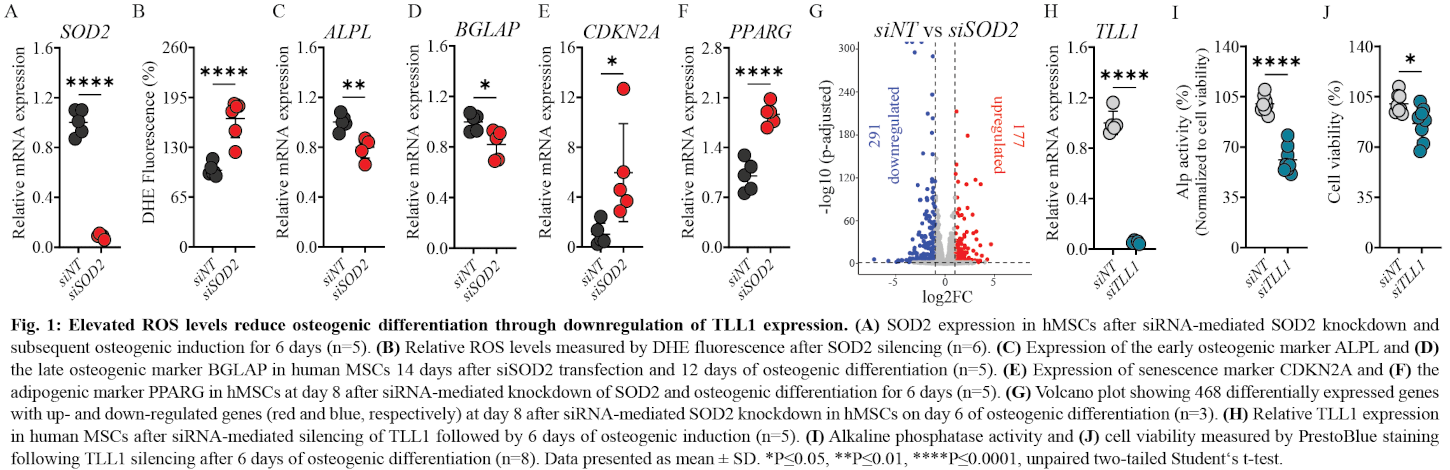
Discussion and conclusions: These results show that elevated ROS levels impair osteogenic differentiation of hMSCs. Reduced osteogenic marker gene expression combined with increased senescence and adipogenic gene expression reflects hallmarks of age-related OP. Transcriptomic analysis identified the metalloprotease TLL1 as a critical downstream target of ROS dysregulation. Functional impairment following TLL1 knockdown highlights its essential role in osteoblast differentiation. As NF-κB has been reported to regulate TLL1 expression, reduced NF-κB signaling upon SOD2 deletion may mechanistically link elevated ROS to suppressed TLL1 expression. These findings suggest that ROS-mediated inhibition of osteogenesis occurs, at least in part, via a SOD2-NF-κB-TLL1 signaling axis.



