
German Congress of Orthopaedics and Traumatology 2026 (DKOU 2026)
Transcutaneous osseointegrated prostheses systems (TOPS) for rehabilitation of patients with traumatic lower limb loss due to war injuries
Text
Objectives and questions: Over the past twenty years, transcutaneous osseointegrated prosthesis systems (TOPS) have become a valuable method for restoring independent movement after lower limb loss. Rehabilitating patients with conventional socket prostheses who have single or double transfemoral amputations due to war injuries is often very difficult, particularly when they have short or extremely short thigh bone remnants, extensive damage to the remaining limb, or foreign bodies embedded from mine or bomb explosions. This study aims to assess the potential for transcutaneous, bone-anchored prosthesis systems to enhance outcomes that are currently considered challenging and often unsatisfactory.
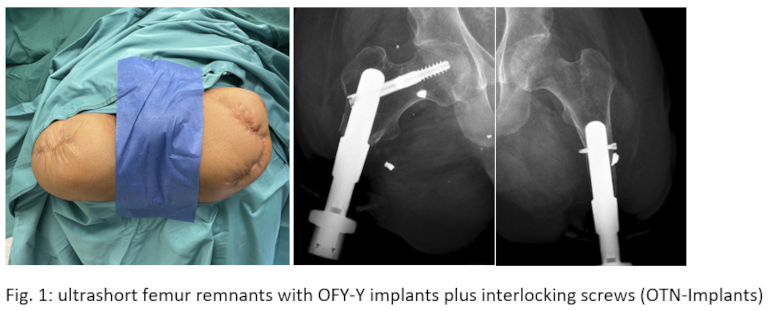
Material and methods: From January 2014, 13 patients with unilateral (n=5) or bilateral (n=8) transfemoral amputations due to war injuries were treated with TOPS (Figure 1 [Fig. 1]). Custom implants were provided by ESKA Orthopaedic (Germany, n=6) and OTN Implants (Netherlands, n=7), with careful consideration for shrapnel and infection risk. All implants were tailored based on CT scans to address trauma-induced anatomical differences. For 10 cases with short femoral remnants, implants (length 60–120 mm) included interlocking screws or bolts at a 130° angle into the femur neck and head. Prior to stem implantation, intramedullary infections were ruled out in 5 patients; all underwent a two-step surgical procedure.
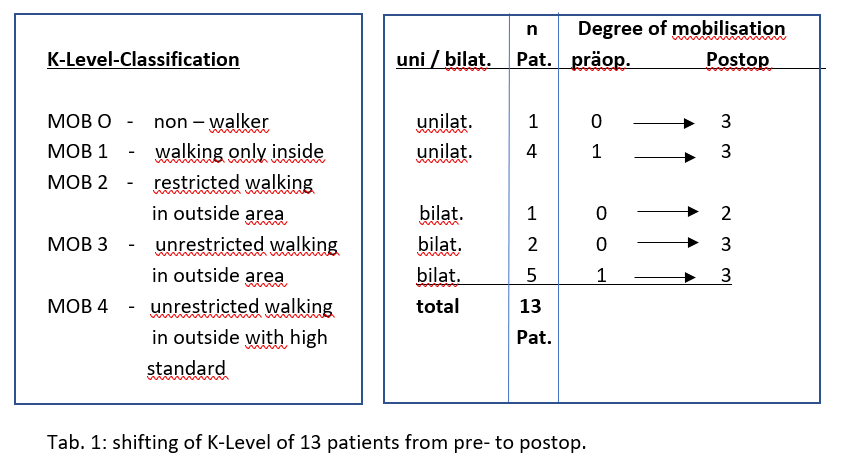
Results: All patients experienced significant improvements in quality of life and mobility, with K-level scores increasing by 2 to 3 points (Table 1 [Tab. 1]). Two required additional surgery for soft-tissue issues near the skin perforation. One patient with bilateral femoral neck and sacrum fractures was successfully treated surgically, and all fractures healed well.
Discussion and conclusions: TOPS provide individualized rehabilitation options after transfemoral amputations from war-related trauma, as long as implants are custom-designed and intramedullary infections are ruled out.



