
German Congress of Orthopaedics and Traumatology 2026 (DKOU 2026)
Zone specific suspension and neurovascular histology of the human lateral meniscus: Implications for repair
Text
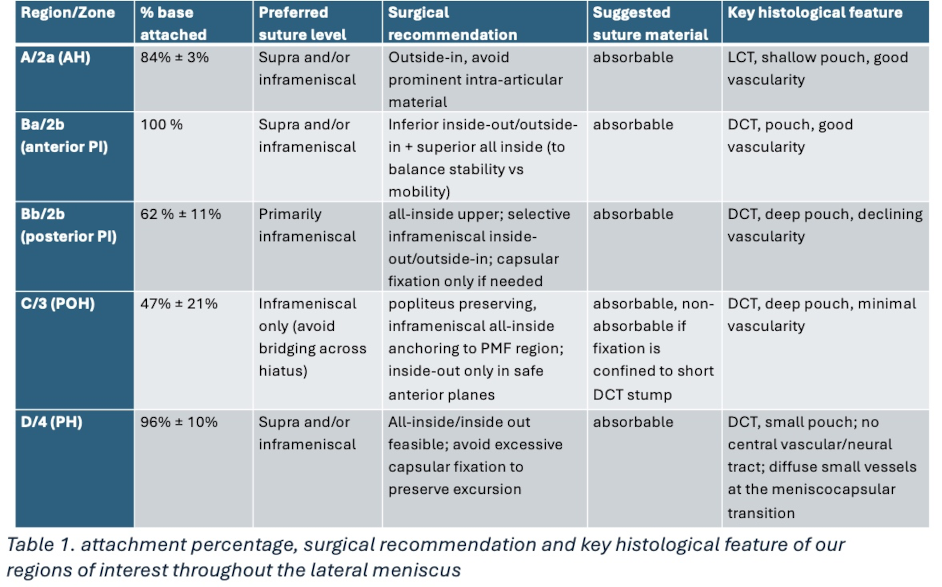
Objectives and questions: To quantify region-dependent variation in meniscosynovial suspension and synovial pouch (SP) architecture of the human lateral meniscus (LM), to map associated neurovascular patterns, and to translate these microanatomical findings into zone-adapted arthroscopic repair concepts (Table 1 [Tab. 1]; Figure 1 [Fig. 1]).
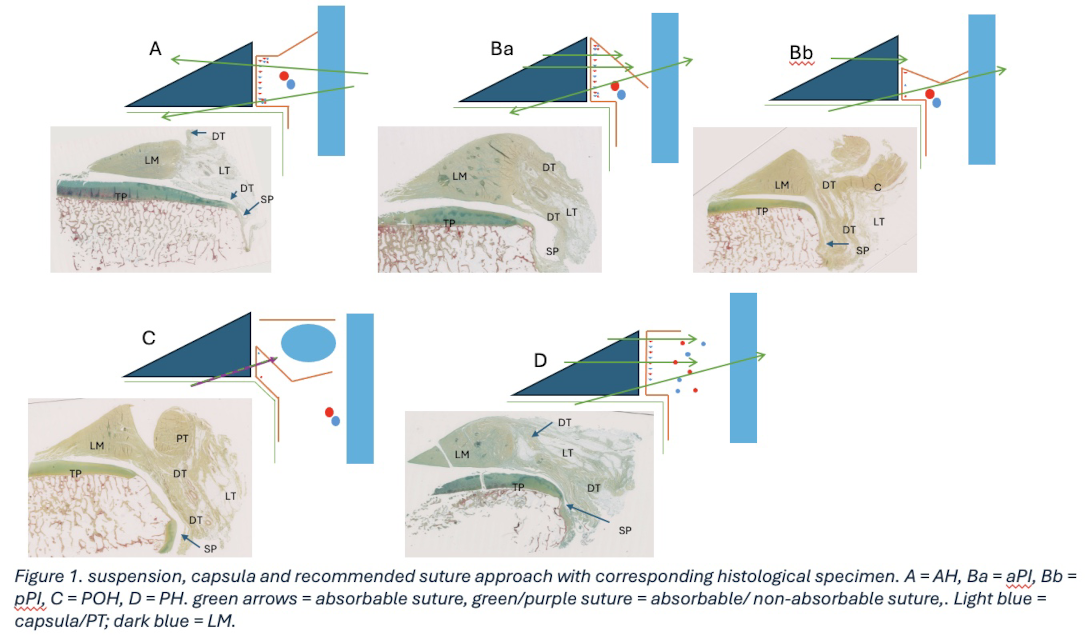
Material and methods: Six fresh-frozen cadaveric knees (mean age 72 years, range 59–83) were examined in a basic science cadaveric laboratory study. A total of 139 histological section planes were analyzed across five predefined regions (A: anterior horn [AH]; Ba: anterior pars intermedia [aPI]; Bb: posterior pars intermedia [pPI]; C: popliteal hiatus [POH]; D: posterior horn [PH]). Hematoxylin–eosin–safran (HES) and Movat’s pentachrome staining were performed; whole-slide images were digitized; calibrated measurements quantified attachment proportion, vessels and nerve fibers were annotated per region.
Results: Meniscal base height attached via meniscosynovial suspension (mean ± SD) was A 84 ± 3%, Ba 100 ± 0%, Bb 62 ± 11%, C 47 ± 21%, and D 96 ± 10%. Region A (loose connective tissue [LCT], shallow SP, central tract; pacinian corpuscles) supports supra- and/or inframeniscal outside-in repair with minimal intra-articular bulk. Region Ba (two dense connective tissue [DCT] bundles, deep SP, sub–mid-height neurovascularity in adipose tissue [AT]) favors hybrid fixation (inferior inside-out/outside-in; superior all-inside). Region Bb (inferior DCT insertion well below the tibial plateau [TP], deep SP, fewer vessels near the base, lateralized larger vessels in AT) suggests primarily inframeniscal base capture with cautious all-inside repair and capsular fixation only when necessary. Region C shows variable, often minimal attachment consistent with popliteomeniscal fascicle (PMF) tissue (inferior iPMF/superior sPMF) and sparse adjacent perimeniscal vascularity; therefore inframeniscal-only, non-bridging, popliteus tendon (PT)- preserving repair anchored to PMF is recommended. Region D (robust converging DCT bundles, small SP, diffuse vessels/nerves at the meniscocapsular transition) permits all-inside or inside-out repair supra- and/or inframeniscally while avoiding overtethering.
Discussion and conclusions: Marked regional heterogeneity of LM suspension and neurovascular anatomy supports differentiated selection of suture level, technique, and material rather than uniform repair across the lateral meniscus. Specifically, suspension-dominant and mobile segments (A/Ba/D) warrant constructs that stabilize the base while minimizing long-term capsular tethering, whereas the POH (C) should be treated as a distinct entity with PMF-based, inframeniscal-only fixation to preserve popliteus-dependent kinematics and avoid bridging across the hiatus. A region-adapted algorithm informed by quantitative suspension metrics (Table 1 [Tab. 1]) and integrated concepts (Figure 1 [Fig. 1]) may improve anatomic restoration, reduce iatrogenic motion restriction, and better address extrusion-prone segments.



