
German Congress of Orthopaedics and Traumatology 2026 (DKOU 2026)
Predicting who will fail TKA and THA revision surgery through artificial intelligence – a random forest–based prediction model
Text
Objectives and questions: Artificial intelligence has been increasingly integrated into orthopedics, from fracture detection and tumor classification to prognostic and diagnostic algorithms. These tools show promise for risk stratification in complex conditions like musculoskeletal infections and have demonstrated good performance in predicting failure after DAIR procedures. However, their role in one- or two-stage revision arthroplasty remains largely unexplored. This study therefore aimed to develop a random forest model to predict septic failure following revision arthroplasty.
Material and methods: This was a single centre retrospective study of 475 patients, consisting of 231 THA (48.6%) and 244 TKA (51.4%) revision surgeries, with 287 aseptic (60.4%) and 188 septic (39.6%) revisions from June 2013 to March 2023 at a minimum follow-up of one year. Infections were defined by applying the EBJIS criteria. A total of 14 variables were included in the analysis (cf. Figure 1 [Fig. 1]). A total of 44 patients (9.3%) failed for reinfection.A gradient boosting decision tree based classification model was trained to predict failure for septic complication. Class imbalances were handled through cost-sensitive learning and five-fold cross-validation was applied. Final evaluation on a 20% hold-out test set included AUC and confusion matrix based metrics. Feature importance was analyzed to identify the most influential predictors. All calculations were performed in R version 4.4.2.
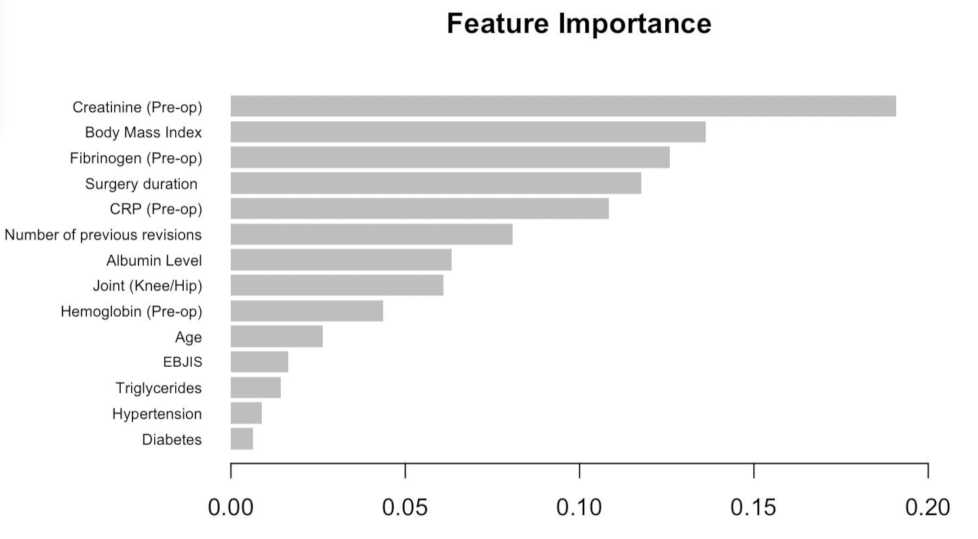
Results: After applying it to the test set, it achieved an area under the ROC curve of 0.77 (cf. Figure 2 [Fig. 2]). The confusion matrix yielded a sensitivity of 0.40, specificity of 0.90, positive predictive value (PPV) of 0.18, negative predictive value (NPV) of 0.96, and accuracy of 0.87. Feature importance analysis identified preoperative creatinine (gain = 0.19), BMI (gain=0.13), and preoperative fibrinogen (gain=0.12) as the most influential variables for predicting septic failure (cf. Figure 1 [Fig. 1]).
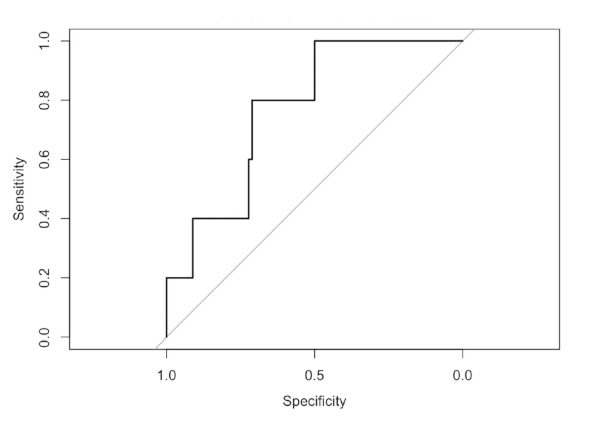
Discussion and conclusions: Gradient boosting models can acceptably predict septic failure after revision arthroplasty of the hip and knee joint. Achieving an AUC of 0.77, the results are comparable to previously developed algorithms for failure prediction after DAIR, which demonstrated a similarly good performance with an AUC of 0.74. The high specificity and negative predictive value point at its utility in ruling out recurrent reinfection, helping to identify patients at relatively low risk. However, the low sensitivity limits its reliability as a definitive rule-out tool, and the low positive predictive value constrains its value in ruling in failure.



