
Deutscher Rheumatologiekongress 2026
Eosinophilic granulomatosis with polyangiitis (EGPA) is associated with an increased risk of mortality and cardiovascular morbidity: A large-scale propensity-matched global retrospective cohort study
Text
Introduction: Despite significantly improved therapies in recent years, long-term morbidity and mortality in ANCA-associated vasculitis (AAV) remain high, attributable to active vasculitis and infections [1], [2]. Cohort analyses suggest an increased risk of cardiac comorbidity in patients with eosinophilic granulomatosis with polyangiitis (EGPA), however, this has been limited due to the limited numbers of patients involved in previous studies [3], [4].
The aim of this study was to analyse mortality and cardiovascular outcomes in an expanded EGPA patient cohort using a comprehensive global clinical database.
Methods: In this retrospective cohort study, data from electronic health records of the US-based TriNetX network database were analyzed [5]. Patients over the age of 18 with the diagnostic code of EGPA and patients without vasculitis as matched controls were included (1:1). Propensity score matching was performed for demographic variables (age, gender, family history of disorder of lipoprotein metabolism, lipidemia) and comorbidity (hypertensive heart disease, cerebrovascular disease, nicotine dependence, overweight and obesity, disorder of lipoprotein metabolism, hypertension, chronic lower respiratory disease, chronic kidney disease, neoplasms, diabetes mellitus) to optimize between-group comparability. Hazard ratios (HR) related to mortality and cardiovascular outcomes (cerebrovascular disease, myocardial infarction, peripheral arterial disease, chronic ischemic heart disease, heart failure, cardiac arrest, ischemic stroke, hemorrhagic stroke, arterial embolism and thrombosis, pulmonary embolism, venous disease, carditis) were calculated by univariate Cox regression after analysis of the matched cohort using the Kaplan-Meier method. The Log-Rank Test was used to determine P values.
Results: A total of 2.651 patients with EGPA were identified (mean age 55.2±16.1 years, 57.1% female). The unadjusted and adjusted relative risk (RR) of mortality was increased (RR 6.60%) in comparison to matched controls (HR: 1.55, P < 0.001) (Figure 1A,B [Fig. 1]). Cardiac-associated morbidity was increased in EGPA: heart failure [RR:14%;HR: 2.11; P = 0.016, Figure 1A,C [Fig. 1]], chronic ischemic heart disease [RR:14,6;HR:1.46; P < 0.001], cardiac arrest [RR: 1.2%;HR: 2.20; P = 0.004], carditis [RR:2.8%; HR: 3.02; P < 0.001] and ischemic stroke (RR:6,1; HR: 1.74; P < 0.0001) (Figure1A [Fig. 1]).
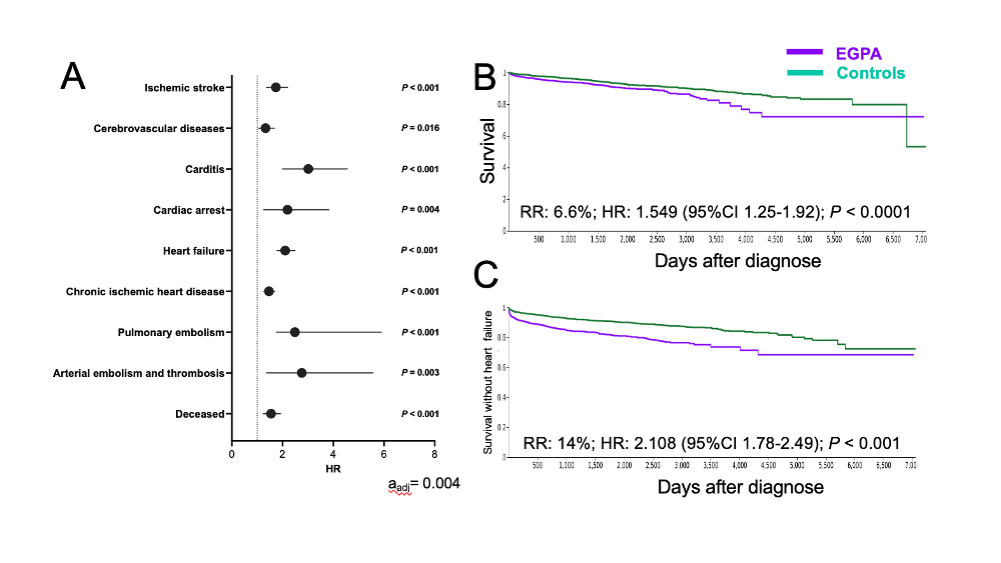
Conclusion: The overall risk for death and cardiac-associated morbidity was increased in patients with EGPA, highlighting the need for targeted monitoring and early therapeutic intervention for organ-specific comorbidities.
Disclosure of interest: Anja Leheis: None declared, Helene Radloff: None declared, Katja von Allwörden: None declared; Sabrina Arnold: None declared, Antje Müller: None declared, Ralf Ludwig: None declared, Peter Lamprecht AstraZeneca, Boehringer Ingelheim, GSK, Janssen, Novartis, UCB, Vifor Pharma, AbbVie, AstraZeneca, GSK, Novartis, UCB, Vifor Pharma, Federal Ministry of Education and Research, German Research Society, John Grube Foundation, Vifor Pharma, Sebastian Klapa: AstraZeneca, Alfasigma, Federal Ministry of Education and Research, Federal Ministry of Defense.
References
[1] Lamprecht P, Kerstein A, Klapa S, Schinke S, Karsten CM, Yu X, Ehlers M, Epplen JT, Holl-Ulrich K, Wiech T, Kalies K, Lange T, Laudien M, Laskay T, Gemoll T, Schumacher U, Ullrich S, Busch H, Ibrahim S, Fischer N, Hasselbacher K, Pries R, Petersen F, Weppner G, Manz R, Humrich JY, Nieberding R, Riemekasten G, Müller A. Pathogenetic and Clinical Aspects of Anti-Neutrophil Cytoplasmic Autoantibody-Associated Vasculitides. Front Immunol. 2018 Apr 9;9:680. DOI: 10.3389/fimmu.2018.00680[2] Sánchez Álamo B, Moi L, Bajema I, Faurschou M, Flossmann O, Hauser T, Hruskova Z, Jayne D, Luqmani R, Mahr A, Åkesson A, Westman K; EUVAS. Long-term outcomes and prognostic factors for survival of patients with ANCA-associated vasculitis. Nephrol Dial Transplant. 2023 Jun 30;38(7):1655-1665. DOI: 10.1093/ndt/gfac320
[3] Hazebroek MR, Kemna MJ, Schalla S, Sanders-van Wijk S, Gerretsen SC, Dennert R, Merken J, Kuznetsova T, Staessen JA, Brunner-La Rocca HP, van Paassen P, Cohen Tervaert JW, Heymans S. Prevalence and prognostic relevance of cardiac involvement in ANCA-associated vasculitis: eosinophilic granulomatosis with polyangiitis and granulomatosis with polyangiitis. Int J Cardiol. 2015 Nov 15;199:170-9. DOI: 10.1016/j.ijcard.2015.06.087
[4] Binzenhöfer L, Strauß K, Seifert L, Saleh I, Scherzer M, Höpler J, Gailis D, Gebhard C, Lichtnekert J, Ullrich F, Singh D, Sonneck T, Thaler M, Zimmer S, Massberg S, Thiele H, Schäfer VS, Nickenig G, Czihal M, Schulze-Koops H, Lüsebrink E. Cardiac disease in patients with vasculitis. Clin Res Cardiol. 2025 Sep;114(9):1216-1231. DOI: 10.1007/s00392-025-02728-y
[5] Palchuk MB, London JW, Perez-Rey D, Drebert ZJ, Winer-Jones JP, Thompson CN, Esposito J, Claerhout B. A global federated real-world data and analytics platform for research. JAMIA Open. 2023 May 13;6(2):ooad035. DOI: 10.1093/jamiaopen/ooad035