
Deutscher Rheumatologiekongress 2026
Bimekizumab and secukinumab use in patients treated in rheumatology setting: A retrospective analysis of German prescription claims data
Text
Introduction: The objective of this analysis was to evaluate the use of bimekizumab (BKZ) and secukinumab (SEC) with a focus on the use of predefined co-medications, in patients treated in routine rheumatology clinical practice in Germany.
Methods: This retrospective cohort study used the Germany-wide Insight Health prescription claims database, covering approximately 64 million statutorily insured individuals. Included were adult new users of BKZ or SEC (first prescription = index date) with at least 9-months pre-index data who were treated in a rheumatology setting. Median treatment persistence was assessed using Kaplan–Meier methodology, defining discontinuation as the absence of a refill within the expected package duration plus a 90-day grace period. Changes in the mean number of prescriptions for pain medication, methotrexate (MTX), glucocorticoids (GC) and antidepressants were evaluated across predefined post-index intervals using the 6-month pre-index period as reference.
Results: A total of 1,098 bio-naïve and 3,489 bio-experienced BKZ patients, and 6,092 bio-naïve and 6,432 bio-experienced SEC patients, were included. Median persistence in BKZ patients was 12.7 months for bio-naïve patients and 15.1 months for bio-experienced patients (SEC: 9.5 and 10.2 months, respectively).
The analysis of co-medications demonstrated clinically relevant reductions under BKZ treatment (Table 1 [Tab. 1]). In bio-naïve BKZ patients needing the respective co-medications, a relevant decrease for number of prescriptions of pain medication (−29%), antidepressants (−35%) and GCs (−45%) 19–24 months post-index was observed (SEC: −11%, −7%, −15%). Among bio-experienced BKZ patients, prescriptions for pain medication, GCs and antidepressants declined by −21%, −14% and −25%; in bio-experienced SEC patients by −9%, −10% and−7%, respectively.
Table 1: Mean number of co-medication prescriptions under BKZ or SEC treatment compared to the last 6 months prior to index (Ref, reference); % change based on aggregated mean change; number of patients varies depending on time period and co-medication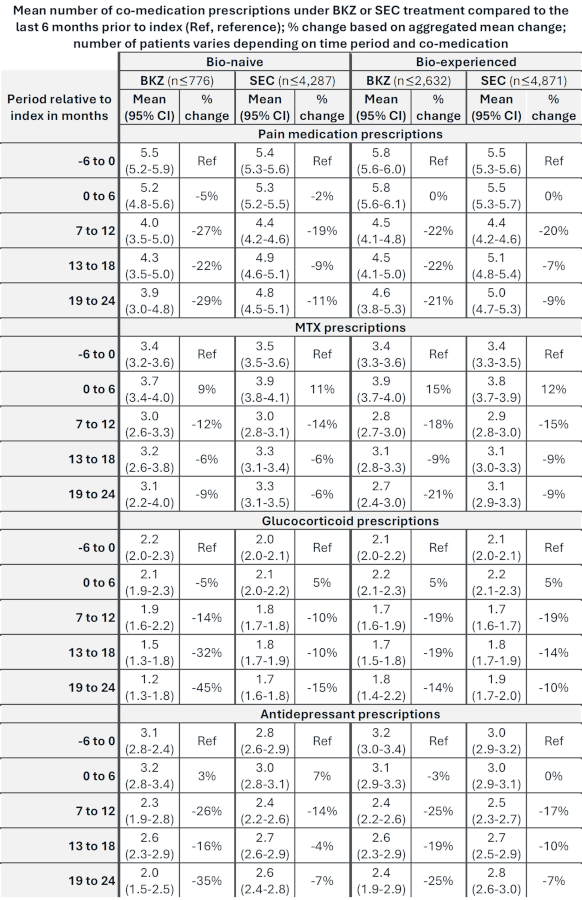
Conclusion: The study suggests potential differences in co-medication patterns between BKZ and SEC users. In rheumatology patients, treatment with BKZ led to meaningful reductions in pain medication, glucocorticoids, and antidepressants in both bio-naïve and bio-experienced patients, suggesting a stronger improvement in overall disease burden with BKZ. In addition, treatment with BKZ was associated with longer treatment persistence compared with SEC in both bio-naïve and bio-experienced patients.
Disclosures: LM, TM, WD, and HDP are employees of UCB pharma. GS and CS received funding from UCB for this study.