Deutscher Rheumatologiekongress 2026
Medication counselling and its influence on adherence to DMARD therapy in inflammatory rheumatic diseases: Interim results from the prospective DRAMA study
Text
Introduction: Medication adherence is a key determinant of treatment success in inflammatory rheumatic diseases (IRDs). While disease-modifying antirheumatic drugs (DMARDs) are highly effective, suboptimal adherence remains common in routine care. The initial medication counselling, particularly the time dedicated to counselling at treatment initiation, may play an important role in supporting adherence, yet real-world data on its impact are limited. The objective of this study is to evaluate the influence of initial medication counselling, with a particular focus on counselling duration, on adherence to DMARD therapy in patients with IRDs.
Methods: DRAMA is a prospective, multicentre study including adult patients with IRDs initiating treatment with a conventional DMARD or a subcutaneous biological DMARD. Patients were recruited at two rheumatology outpatient clinics. Eligible patients were ≥18 years of age with a confirmed diagnosis of rheumatoid arthritis, psoriatic arthritis or axial spondyloarthritis. At the initial visit, rheumatologists documented the duration and characteristics of the medication counselling, and patients subsequently rated the quality of the initial counselling using structured questionnaires. The primary endpoint of the study is medication adherence at 6 months, assessed using the German version of the Medication Adherence Report Scale (MARS-D) [1]. The scale ranges from 1-5, a MARS Score of 5 indicates full adherence. For this interim analysis, patient-reported adherence after 3 months was analysed. The study was approved by the local ethics committee (ethical vote 25-50-B) and registered in the German Clinical Trials Register (DRKS00036957).
Results: Recruitment was initiated on 4th of June 2025 up to 11th of January 2026 85 patients were included in the study. The majority received counseling for Methotrexate (49.4%), Adalimumab (24.7%) or Etanercept (16.5%).
Among the 85 patients, counselling quality was rated highly. Adequate time and clear information were reported by 97.7% of patients. Clear explanation of side effects was reportedby 88.2%, and 91.8% felt confident to correctly take or administer their medication. Active involvement in treatment decisions was reported by 88.2%. Overall satisfaction was high, with 96.5% fully satisfied. In an overall rating (1 to 6, 1 = best), 86.8% graded the counselling with the highest mark. Fifteen rheumatologists across different career stages were involved in medication counselling (Table 1 [Tab. 1]).
Table 1: Baseline characteristics of participating rheumatologists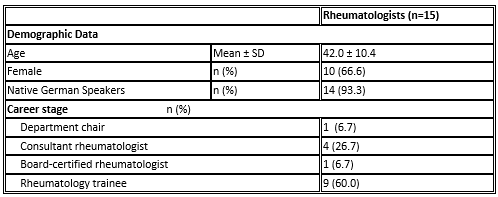
Three-month follow-up data were available for 52 patients (Table 2 [Tab. 2]). Thirty-three patients reported complete adherence (MARS-D = 5), while 19 (36.6%) showed incomplete adherence.
Table 2: Baseline and counselling characteristics stratified by 3-month medication adherence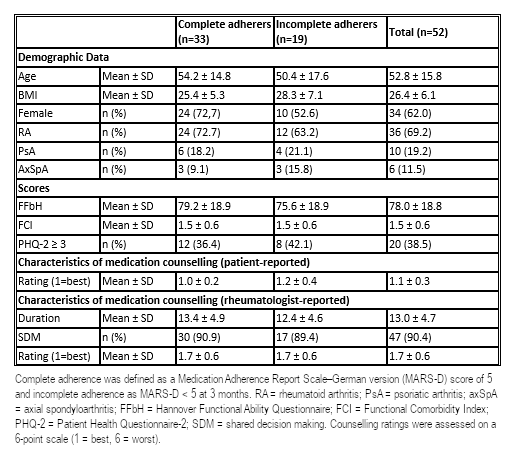
The duration of initial medical counselling did not differ significantly between patients with complete and incomplete adherence (complete: median = 12.7 min, Q1–Q3 = 11.1–15.7; incomplete: median = 12.5 min, Q1–Q3 = 9.64–15.0; p = 0.648). Furthermore, counseling duration showed a negligible association with adherence as measured by the MARS-D (Spearman’s ρ = 0.001). Shared decision making was documented in 90.9% and 89.4% of consultations in the complete and incomplete adherence groups, respectively.
Conclusion: Initial DMARD counselling was rated highly and shared decision making was frequently documented. Nevertheless, a substantial proportion of patients did not achieve complete adherence at 3 months. No significant difference in counselling duration was observed between patients with complete and incomplete adherence in this interim analysis
Disclosures: Die Autoren erklären, dass im Zusammenhang mit dieser Studie keine Interessenkonflikte bestehen.