Deutscher Rheumatologiekongress 2026
Rheumatic comorbidity in breast cancer: Clinicopathologic characteristics and event-free survival in the MalheuR cohort
Text
Introduction: Clinical data on the coexistence of breast cancer (BC) and rheumatic and musculoskeletal diseases (RMDs) remain limited. We investigated whether pre-existing or newly diagnosed RMDs are associated with clinicopathologic characteristics, treatment patterns, and oncologic outcomes in patients with BC.
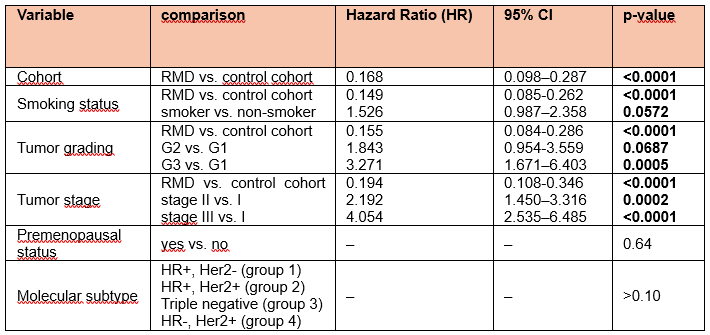
Methods: This retrospective, non-randomized cohort study, 167 patients with BC and RMDs from the MalheuR project (n=167, DRKS00036681), were compared with 1,190 BC controls without RMDs. The RMD cohort comprised 98 patients with pre-existing RMDs and 69 with newly diagnosed RMDs after BC diagnosis. Event-free survival (EFS) was estimated using the Kaplan-Meier method, defined as the time from initiation of breast cancer treatment to oncological progression, including distant metastasis, local recurrence, contralateral carcinoma or death due to breast cancer. Survival curves were compared using the log-rank test, and univariate and multivariate Cox regression models identified the prognostic impact of variables while excluding stage IV patients to avoid bias. A p-value of < 0.05 was considered statistically significant.
Results: Median follow-up was 80 months for the RMD cohort and 33 months in controls. Patients with RMDs were younger at BC diagnosis (median 53 [IQR 46–64]) vs. (57 [IQR 48–67] years, p=0.0129), more often premenopausal (42.5% vs. 29.5%, p=0.0003), had a slightly higher median BMI (25.2 vs, 24.5, p=0.049), and more frequently reported current or former smoking (27% vs. 9.7%, p<0.0001). Prior malignancies were more common in the RMD cohort (12.5% vs. 7.9%). Tumor stage distribution differed, with more stage I tumors in patients with RMD (42.0% vs. 31.7%), whereas stage III, IV disease was more frequent in controls (11.4 vs.18%). Major treatment modalities were comparable between groups. Both cohorts utilized tamoxifen as the primary endocrine therapy, but a second-line antihormonal agent was introduced more frequently in RMD cohort, triggered by adverse reactions. Event and mortality rates were similar, but time to events was significantly longer in the RMD cohort (log-rank p=0.0001) and a higher number of local recurrences (8.9% vs. 4.8%). Univariate and multivariate Cox regression models revealed that RMD patients were significantly less likely to experience events (HR = 0.168, p<0.0001) compared to controls, even after adjusting for confounders like smoking status, tumor stage and grading. Premenopausal status and molecular subtype were not significantly associated with event occurrence. RMD patients showed improved EFS across comparisons including smoking status, tumor stage and grading.
Conclusion: In this cohort-wide analysis, rheumatic comorbidity was associated with prolonged EFS despite similar treatment patterns, and higher smoking rates. Whether this finding reflects differences in medical surveillance, biological mechanisms (e.g. sustained immune activation/enhanced antitumor immune response), or treatment-related factors remains unclear and should be addressed in further studies.
Disclosures: Karolina Gente has received an Exzellenz Stipendium fellowship from the Else Kröner-Fresenius-Stiftung for her research on the coincidence of malignant and rheumatic disorders in the MalheuR project. She has also received grants, research support, and speaker/consulting fees from AbbVie, BMS, Gilead/Galapagos, Janssen, Lilly, Medac, MSD, Novartis, Roche, Sandoz/Hexal, UCB, Viatris.
Figure 1 [Fig. 1]
Figure 1: Kaplan Meier curves, EFS in RMD cohort vs. control cohort for patients with stage I vs. stage II+III disease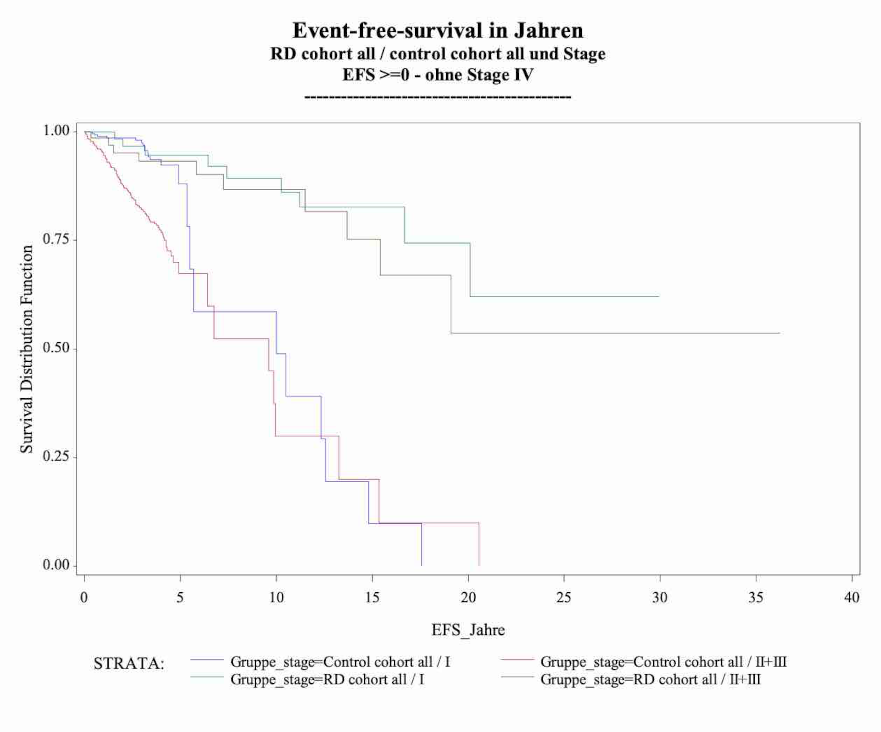
Table 1 [Tab. 1]