
Logo

Deutscher Rheumatologiekongress 2026

54. Kongress der Deutschen Gesellschaft für Rheumatologie und Klinische Immunologie (DGRh), 36. Jahrestagung der Gesellschaft für Kinder- und Jugendrheumatologie (GKJR), 40. Jahrestagung der Deutschen Gesellschaft für Orthopädische Rheumatologie (DGORh)
09.-12.09.2026
Leipzig

Meeting Abstract

Contextual factors used for statistical adjustment in longitudinal observational studies in rheumatoid arthritis: A scoping review from the OMERACT Contextual Factors Working Group

Max Weinbrecht-Mischkewitz - Department of Pediatrics, Medical University Lausitz – Carl Thiem, Cottbus, Deutschland; Epidemiology and Health Services Research, Berlin, Deutschland; Section for Biostatistics and Evidence-Based Research, the Parker Institute, Bispebjerg and Frederiksberg Hospital, Copenhagen, Dänemark
Aidan G. Cashin - Centre for Pain IMPACT, Neuroscience Research Australia, Sydney, Australia; School of Population Health, Faculty of Medicine and Health, University of New South Wales, Sydney, Australia
Saurab Sharma - Pain Management Research Institute, Kolling Institute, Sydney Medical School, Faculty of Medicine and Health, The University of Sydney, Sydney, Australia; School of Population Health, Faculty of Medicine and Health, University of New South Wales, Sydney, Australia; Centre for Pain IMPACT, Neuroscience Research Australia, Sydney, Australia; Pain Management and Research Centre, Royal North Shore Hospital, Northern Sydney Local Health District, Sydney, Australia
Tobias Haugegaard - Research Unit of Rheumatology, Department of Clinical Research, University of Southern Denmark, Odense University Hospital, Odense, Dänemark; Section for Biostatistics and Evidence-Based Research, the Parker Institute, Bispebjerg and Frederiksberg Hospital, Copenhagen, Dänemark
Wils Nielsen - University of Toronto Lupus Clinic, Centre for Prognosis Studies in Rheumatic Diseases, Toronto Western Hospital, Toronto, Canada; Institute of Medical Science, University of Toronto, Toronto, Canada; Schroeder Arthritis Institute, Krembil Research Institute, University Health Network, Toronto, Canada
Midhat Kamal - MS Delta Family Medicine Residency, Greenville, USA; Dow University of Health Sciences, Karachi, Pakistan; Section for Biostatistics and Evidence-Based Research, the Parker Institute, Bispebjerg and Frederiksberg Hospital, Copenhagen, Dänemark
Areeba M. Khan - Dow University of Health Sciences, Karachi, Pakistan; Section for Biostatistics and Evidence-Based Research, the Parker Institute, Bispebjerg and Frederiksberg Hospital, Copenhagen, Dänemark
Farwa Asim - Department of Internal Medicine, Piedmont Hospital, Macon, USA; Section for Biostatistics and Evidence-Based Research, the Parker Institute, Bispebjerg and Frederiksberg Hospital, Copenhagen, Dänemark
Maria A. Lopez-Olivo - The University of Texas MD Anderson Cancer Center, Houston, USA
Loreto Carmona - Instituto de Salud Musculoesquelética, Madrid, Spain
Allyson Jones - Department of Physical Therapy, University of Alberta, Edmonton, Canada
Jasvinder A. Singh - Medicine Service, VA Medical Center, Birmingham, USA; Department of Medicine at the School of Medicine, University of Alabama at Birmingham, Birmingham, USA; Department of Medicine, Baylor College of Medicine, Houston, USA
Thasia Woodworth - Division of Rheumatology, David Geffen School of Medicine, University of California, Los Angeles, USA
Daniel E. Furst - Division of Rheumatology, David Geffen School of Medicine, University of California, Los Angeles, USA; University of Florence, Florence, USA; Division of Rheumatology, University of Washington, Seattle, USA
Reuben Escorpizo - Department of Rehabilitation and Movement Science, College of Nursing and Health Sciences, University of Vermont, Burlington, USA
Mike Gill - OMERACT Patient Research Partner, Founder Dragon Claw Charity Ltd, Annandale, Australia
Niti Goel - OMERACT Patient Research Partner, Department of Medicine, Division of Rheumatology, Duke University School of Medicine, Durham, USA
Maria E. Suarez-Almazor - The University of Texas MD Anderson Cancer Center, Houston, USA
Lyn March - Florance and Cope Professorial Department of Rheumatology, Royal North Shore Hospital and Kolling Institute, Faculty of Medicine and Health, University of Sydney, Sydney, Australia
Peter Tugwell - Department of Medicine and School of Epidemiology and Public Health, Bruyère Research Institute, Ottawa Hospital Research Institute, University of Ottawa, Ottawa, Canada
Rieke Alten - Department of Internal Medicine, Rheumatology, Clinical Immunology and Osteology, Schlosspark-Klinik University Medicine Berlin, Berlin, Deutschland
Robin Christensen - Research Unit of Rheumatology, Department of Clinical Research, University of Southern Denmark, Odense University Hospital, Odense, Dänemark; Section for Biostatistics and Evidence-Based Research, the Parker Institute, Bispebjerg and Frederiksberg Hospital, Copenhagen, Dänemark
Sabrina M. Nielsen - Section for Biostatistics and Evidence-Based Research, the Parker Institute, Bispebjerg and Frederiksberg Hospital, Copenhagen, Dänemark

Text

Introduction: The Outcome Measures in Rheumatology (OMERACT) initiative defines a Contextual Factor (CF) as a “variable that is not an outcome of the study but needs to be recognized (and measured) to understand the study results” [1]. Building on this definition, the OMERACT Contextual Factors Working Group (CFWG) further characterised Outcome Influencing Contextual Factors (OI-CFs) as prognostic factors. Thus, OI-CFs are potential confounders that are relevant to adjust for in longitudinal observational studies (LOS) [2]. We conducted a scoping review of baseline variables most frequently adjusted for in LOS of rheumatoid arthritis (RA), which represent potential OI-CFs.

Methods: A protocol was preregistered online [3]. This study was based on the LOS in RA included in a previous systematic review by Lopez-Olivo et al. [4]. Eligible studies for this scoping review investigated the association between any exposures/interventions and clinical or patient-centred outcomes. Two independent reviewers screened the publications, with disagreements resolved by a third reviewer. Data extraction was performed by one reviewer and verified by a second reviewer. A third reviewer reconciled any discrepancies. We extracted study characteristics, and all baseline variables reported to be adjusted for in the analyses. These were subsequently categorised into domains and synthesised using descriptive statistics.

Results: A total of 1,623 publications were screened, of which 276 met the inclusion criteria. These studies enrolled a median of 1,141 participants (interquartile range 546–2,659). Most studies investigated pharmacological interventions (155 studies [56.2%]). The most frequently reported outcomes were related to disease activity (111 studies [40.2%]) (Table 1 [Tab. 1]). Overall, the baseline variables most frequently adjusted for were sex/gender (192 [70%]), age (189 [68%]), treatment history/status (139 [50%]), disease activity (118 [43%]), and laboratory-based domains (116 [42%]) (Figure 1 [Fig. 1]). Overall, 16% (43/276) of the studies did not report any factors used for adjustment.

Table 1: Study characteristics.
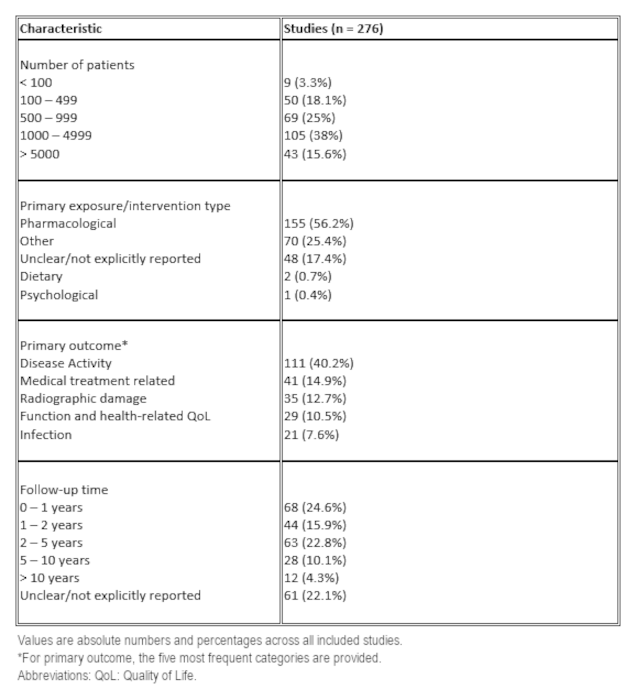
Figure 1: Domains of baseline variables most frequently adjusted for. Values are absolute numbers and percentages across all included studies.
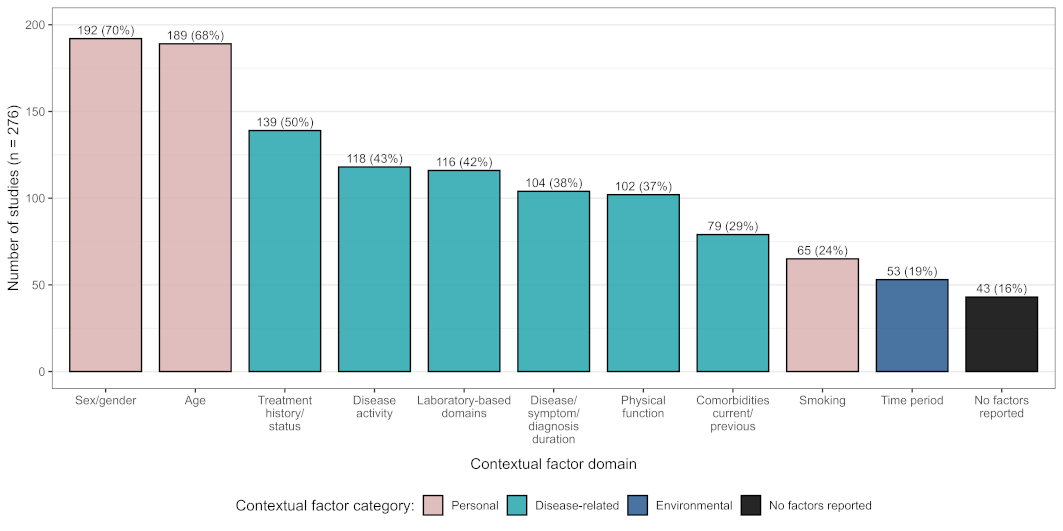
Conclusion: The baseline variables adjusted for in RA LOS varied considerably across the studies. Only a few factors – age, sex/gender, and treatment history/status – were reported to have been adjusted for in at least half of the studies. The collected domains may be candidates for a generic set of potentially important OI-CFs for future research.

Disclosures: The authors have no conflicts of interest.


References

[1] Boers M, Kirwan JR, Wells G, Beaton D, Gossec L, d'Agostino MA, Conaghan PG, Bingham CO 3rd, Brooks P, Landewé R, March L, Simon LS, Singh JA, Strand V, Tugwell P. Developing core outcome measurement sets for clinical trials: OMERACT filter 2.0. J Clin Epidemiol. 2014 Jul;67(7):745-53. DOI: 10.1016/j.jclinepi.2013.11.013
[2] Nielsen SM, Boers M, de Wit M, Shea B, van der Windt DA, Reeves BC, Beaton D, Alten R, Toupin April K, Boonen A, Escorpizo R, Flurey C, Furst DE, Guillemin F, Leong A, Pohl C, Rasmussen MU, Singh JA, Smolen JS, Strand V, Verstappen SMM, Voshaar M, Woodworth TG, Ellingsen T, March L, Wells GA, Tugwell P, Christensen R. OMERACT consensus-based operational definition of contextual factors in rheumatology clinical trials: A mixed methods study. Semin Arthritis Rheum. 2021 Jun;51(3):601-606. DOI: 10.1016/j.semarthrit.2021.03.013
[3] Mischkewitz M. Outcome Influencing Contextual Factors in Rheumatoid Arthritis: a Scoping Review. OSF; 2022.
[4] Lopez-Olivo MA, Zogala RJ, des Bordes J, Zamora NV, Christensen R, Rai D, Goel N, Carmona L, Pratt G, Strand V, Suarez-Almazor ME. Outcomes Reported in Prospective Long-Term Observational Studies and Registries of Patients With Rheumatoid Arthritis Worldwide: An Outcome Measures in Rheumatology Systematic Review. Arthritis Care Res (Hoboken). 2021 May;73(5):649-657. DOI: 10.1002/acr.24163