
Deutscher Rheumatologiekongress 2026
Tocilizumab-induced neutropenia: Mechanisms investigated using in-vivo and in-vitro models
Text
Introduction: Tocilizumab (TCZ) is a monoclonal antibody targeting IL-6R, used to treat several autoimmune diseases. However, up to 30% of patients treated with TCZ develop neutropenia, potentially leading to treatment interruptions [1], [2], [3]. The underlying mechanisms are still debated, with theories including impaired granulopoiesis, increased neutrophil apoptosis, and reversible intravascular margination causing “pseudo-neutropenia” [1], [2], [3]. This study aims to investigate these mechanisms in both in-vivo and in-vitro models.
Methods: A multimethodological approach was employed, encompassing retrospective patient data analysis, the use of transgenic zebrafish lines, such as Zf(mpx:gfp), for in-vivo testing, and primary cell cultures for in-vitro toxicity and differentiation studies. In the zebrafish model, larvae were injected with varying concentrations of TCZ, or phosphate-buffered saline (PBS), and analyzed at 2-3 days post-fertilization (dpf) using fluorescence microscopy. For in-vitro experiments, primary CD34+ cells were treated with TCZ, Sarilumab, PBS, or Ustekinumab, followed by toxicity testing and liquid culture differentiation (LCD).
Results: Analysis of patient data revealed that 44% of patients (preliminary data from a spot sample with N=36) experienced neutropenia shortly after starting TCZ therapy, with CTCAE grades ranging from 1 to 4. This finding is consistent with existing data [4-5]. Recovery occurred either spontaneously or after treatment discontinuation. Injection of TCZ into Zf(mpx:gfp) larvae was implemented and resulted in a significant decrease in GFP+ neutrophils (Figure 1 [Fig. 1]; preliminary data). No alterations in Zf(CD41:gfp) larvae (CD41 being a marker for hematopoietic stem cells) or cmyb expression (marker for hematopoietic progenitors) were observed, suggesting that TCZ does not affect early progenitor cell differentiation. No evidence of cellular toxicity was observed in primary CD34+ cells. LCDs exhibited a consistent dose-dependent shift towards immature cells when treated with TCZ or Sarilumab compared to PBS or Ustekinumab (Figure 2 [Fig. 2]; preliminary data).
Figure 1: Absolute counts of GFP+ cells in hematopoietic site in Zf(mpx:gfp) at 3 dpf, injected with TCZ (50 µM, 100 µM, 200 µM) versus PBS at 2 dpf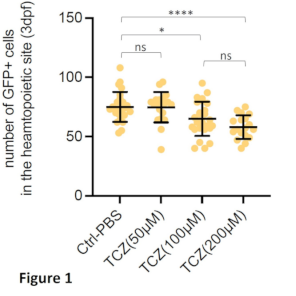
Figure 2: Proportion of various stages of differentiation, from myeloblasts to polymorphonuclear neutrophils, among all viable CD45+ cells on day 14 of LCD using CD34+ primary cells treated with different concentrations of TCZ or sarilumab as treatment versus PBS or ustekinumab as control.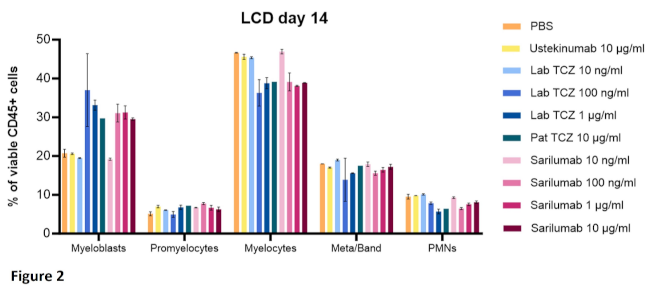
Conclusion: We successfully implemented a zebrafish in-vivo model that offers a valuable platform for studying drug-induced hematologic adverse effects. With regard to TCZ-induced neutropenia, our results suggest an impaired granulopoiesis as one crucial underlying mechanism, rather than an exclusive “pseudo-neutropenia” due to altered neutrophil distribution. This finding supports dose adjustments or therapy discontinuation in patients with severe neutropenia.
Disclosures: The authors declare no conflict of interests.
References
[1] Gabay C, et al. Safety and efficacy of tocilizumab in patients with rheumatoid arthritis. Clinical and Experimental Rheumatology. 2013;31(2):197-208.[2] Nagamine H, et al. Tocilizumab-induced neutropenia: a review of the literature. Annals of the Rheumatic Diseases. 2009;68(9):1497-1501.
[3] Lok N, et al. Pseudo-neutropenia during tocilizumab treatment: a clinical and molecular investigation. Rheumatology International. 2017;37(7):1057-1064.
[4] Moots RJ, et al. The effect of tocilizumab on neutropenia in patients with rheumatoid arthritis. Rheumatology. 2017;56(2):211-218.
[5] Gabay C, et al. Tocilizumab in the treatment of rheumatoid arthritis: efficacy, safety, and pharmacodynamics. Nature Reviews Rheumatology. 2013;9(8):469-480.