
Deutscher Rheumatologiekongress 2026
Changes in glycosylation of anti-Ro52 IgG and total IgG are linked to autoimmune congenital heart block
Text
Introduction: Congenital autoimmune heart block (CHB) is a rare disorder caused by transplacental transfer of maternal anti-Ro/SSA and anti-La/SSB autoantibodies. Alterations in IgG Fc N-linked glycosylation, characteristic of many systemic autoimmune diseases, are markedly influenced by pregnancy [1]. However, their role in congenital heart block in neonates of anti-SSA–positive women remains unclear.
Methods: IgG Fc glycosylation composition (Figure 1A [Fig. 1]) of antigen-specific (anti-Ro52-, anti-Ro60- and anti-La-IgG) as well as of total IgG was analyzed by an immunosorbent assay followed by liquid chromatography-mass spectrometry [2]. Plasma from 12 pregnant women experiencing a CHB complication, 28 pregnancies positive for anti-Ro/SS-A antibodies without CHB (at-risk) and 18 healthy pregnant women were processed and analyzed accordingly.
Figure 1: (A) Schematic glycosylation composition of IgG Fc part. (B) Significant changes in glycosylation of total IgG and (C) anti-Ro52-Ab between at-risk and CHB pregnancies. AR = at-risk, CHB = congenital heart block. G0 = agalactosylated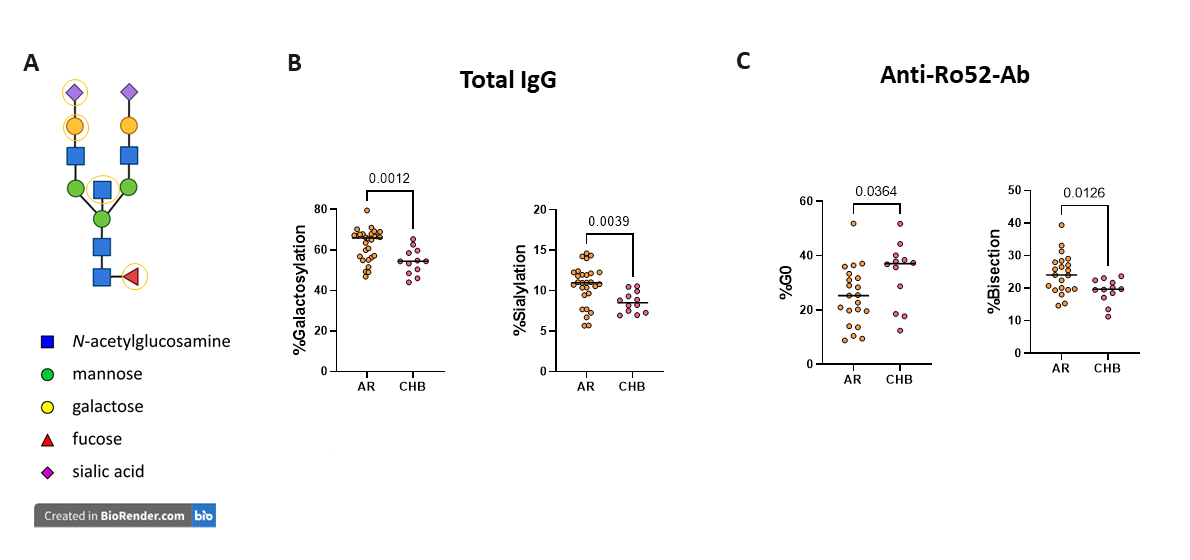
Results: Total IgG glycosylation in CHB pregnancies exhibited significantly lower galactosylation and sialylation levels compared with at-risk and healthy pregnancies (Figure 1B [Fig. 1]). Regarding antigen-specific autoantibodies, anti-Ro52 IgG Fc glycosylation showed higher agalactosylated (G0) and lower GlcNAc bisection levels in CHB compared with at-risk pregnancies (Figure 1C [Fig. 1]), while no changes were observed in anti-Ro60 and anti-La IgG Fc glycosylation. Interestingly, while for total IgG the Fc glycosylation differences persisted also postpartum between the groups, this was not the case with respect to antigen-specific anti-Ro52 IgG.
Conclusion: This study provides the first evidence linking CHB to Fc glycosylation profiles of maternal anti-Ro52 IgG and total IgG during pregnancy. Although IgG glycosylation is complex and poorly understood, these findings provide new insights into CHB pathogenesis and may help identify high-risk pregnancies and guide targeted interventions. Future mechanistic studies are needed to elucidate the specific pregnancy-associated tolerogenic mechanisms that may influence the composition of Fc glycopeptides.
References
[1] Bondt A, Rombouts Y, Selman MH, Hensbergen PJ, Reiding KR, Hazes JM, Dolhain RJ, Wuhrer M. Immunoglobulin G (IgG) Fab glycosylation analysis using a new mass spectrometric high-throughput profiling method reveals pregnancy-associated changes. Mol Cell Proteomics. 2014 Nov;13(11):3029-39. DOI: 10.1074/mcp.M114.039537[2] Falck D, Wuhrer M. GlYcoLISA: antigen-specific and subclass-specific IgG Fc glycosylation analysis based on an immunosorbent assay with an LC-MS readout. Nat Protoc. 2024 Jun;19(6):1887-1909. DOI: 10.1038/s41596-024-00963-7