
German Congress of Orthopaedics and Traumatology 2026 (DKOU 2026)
Three-dimensional planning in multiplanar femoral reconstruction: A modified clamshell approach
Text
Objectives and questions: To present a complex femoral reconstruction using a modified clamshell osteotomy assisted by three-dimensional (3D) preoperative planning, aimed at achieving simultaneous correction of limb length discrepancy, angular deformity, and rotational malalignment in a post-traumatic femoral deformity.
Material and methods: We prospectively report the case of a 54-year-old male with a history of intertrochanteric and subtrochanteric femoral fracture secondary to a high-energy traffic accident, initially treated with cephalomedullary nailing. The patient evolved with malunion and subtrochanteric nonunion, resulting in a 6 cm limb length discrepancy. A subsequent bone transport procedure reduced the discrepancy to 2.7 cm; however, persistent proximal femoral malrotation of 12° remained, associated with significant gait impairment and mechanical axis deviation.Preoperative 3D reconstruction and planning were performed using the contralateral femur as a template to define the magnitude of rotational correction and required length restoration. A modified femoral clamshell osteotomy was designed to allow controlled multiplanar correction and stable intramedullary fixation in a single-stage procedure (Figure 1 [Fig. 1]). As this is a single-case prospective report, outcomes were evaluated descriptively through clinical and radiographic follow-up without inferential statistical analysis.
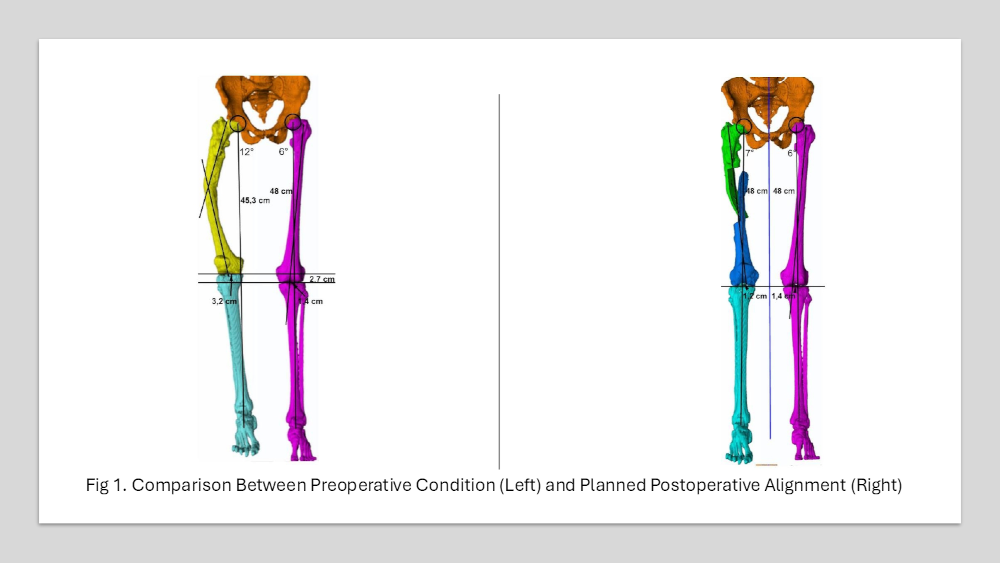
Results: The modified clamshell technique enabled accurate correction of the 12° rotational deformity, restoration of the residual 2.7 cm limb length discrepancy, and re-establishment of the mechanical axis. Intraoperative alignment corresponded closely with the preoperative 3D plan. At 3-month follow-up, the patient demonstrated progressive radiographic consolidation, substantial improvement in gait mechanics, and maintenance of length and rotational correction.
Discussion and conclusions: 3D-assisted modified clamshell osteotomy represents a strategy for the management of complex femoral deformities, allowing precise, reproducible, and simultaneous correction of rotational and longitudinal discrepancies. The use of contralateral anatomical referencing enhances surgical accuracy and may reduce residual deformity.



