
German Congress of Orthopaedics and Traumatology 2026 (DKOU 2026)
In silico biomechanical investigation of ankle-foot orthoses using a physiological lower-leg model
Text
Objectives and questions: Ankle-foot orthoses (AFOs) are widely used to support ankle joint function and improve mobility in various lower-limb conditions, including ligament injuries. Despite their clinical use, the biomechanical interactions between the foot and AFOs are not fully understood and objective evidence on how AFOs affect joint kinematics and muscle force generation is limited. The aim of this computational study is to analyze ankle joint function in interaction with an AFO. We investigate design-related differences in biomechanical function using a novel 3D physics-based model of the lower leg under simulated ligament injury scenarios.
Material and methods: A subject-specific continuum mechanical lower-leg model (Figure 1 [Fig. 1]) is generated from magnetic resonance imaging data of a 43-year-old male. Bones, ligaments, tendons, muscles, fat, and skin are segmented and discretized for efficient finite-element (FE) simulations. The muscle tendon unit (MTU) is described as a 3D nonlinear, anisotropic material model, where the muscle behaviour is governed by a Hill-type constitutive law. The MTU system of the lower leg is initialized with an inherent stress state to establish joint stiffness. To generate open-chain foot motion, the lower-leg muscles are contracted in a controlled synergy corresponding to the EMG signals and motion capture data. Physiological joint motion takes place at the articulating surfaces derived from segmented bone geometries, while the ligament structures stabilize motion and limit excessive rotational movements. We modeled a commercially available AFO Malleo Cast Organic S1 (Sporlastic, Germany) comprising a polyamide shell with organic structure for material reduction, cushion, and elastic strap components that define its specific fixation system on the foot. Open-chain ankle motion is simulated under identical muscle activation patterns with and without the AFO. The effects of the fixation system and the influence of ruptured ligaments on joint biomechanics are evaluated through a sensitivity study.
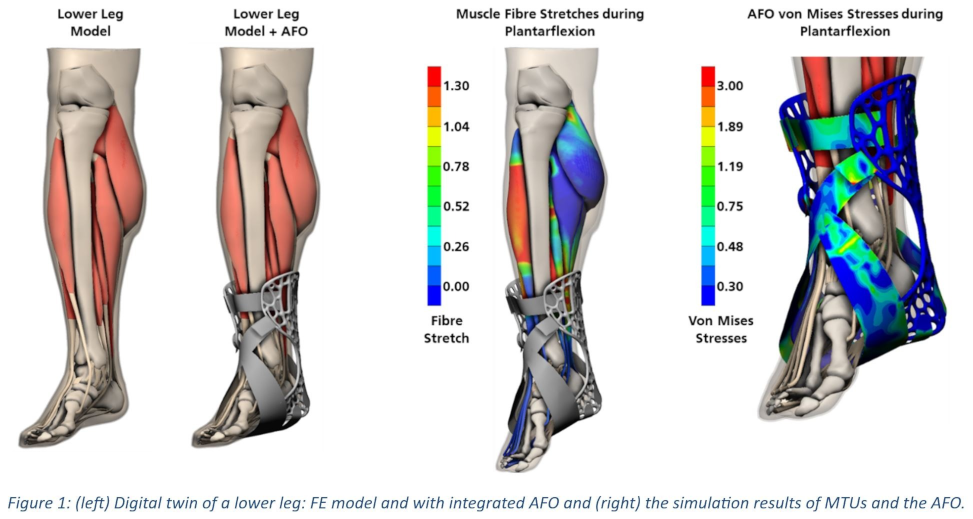
Results: The sensitivity study shows that the presence of the AFO results in altered motion patterns and increases the resistance primarily against eversion and inversion. Consequently, due to the restricted range of motion, ligament strains are reduced compared to the condition without an AFO. The resulting ankle kinematics, muscle forces, soft tissue stress and deformations, as well as the mechanical response of the AFO, are quantified and illustrated in Figure 1 [Fig. 1].
Discussion and conclusions: This in silico study reveals the impact of the AFO on joint kinematics, muscle forces, and soft tissue deformations. The presented simulation approach allows comparative evaluation of AFO designs and provides a framework for predicting AFO function in various muscular disorders and ligament injuries. These simulations enable direct comparisons under standardized loading and activation scenarios, offering high potential for AFO design optimization and individualization.



