
Deutscher Kongress für Orthopädie und Unfallchirurgie 2026 (DKOU 2026)
CERAchange study: Clinical applications of Cerament G & V in periprosthetic infections and two-stage total hip arthroplasty exchange
Text
Objectives and questions: Two-stage exchange remains the gold standard for the treatment of chronic periprosthetic joint infection (PJI). Biodegradable antibiotic carriers such as Cerament® G (gentamicin-loaded) and Cerament® V (vancomycin-loaded) have emerged as potential alternatives to conventional gentamicin and vancomycin-loaded polymethylmethacrylate (PMMA) spacers, offering high local antibiotic concentrations without the need for later removal. This study compares clinical and pharmacokinetic outcomes of Cerament® versus PMMA in two-stage revision arthroplasty.
Material and methods: A total of 17 patients undergoing two-stage revision for confirmed PJI were included prospectively up to date. Eight patients received Cerament® G & V, and nine patients were treated with Gentamicin and Vancomycin antibiotic-loaded PMMA. The mean age was 66.3 years; 15 patients were male and 2 female. Preoperative diagnosis of PJI was established by diagnostic hip joint aspiration with pathological synovial fluid cell count and positive microbiological findings. Intraoperative histological analysis confirmed infection in all included cases. Both groups underwent implant explantation followed by placement of either Cerament® or PMMA. A planned interval of six weeks between stages was applied. Reimplantation was performed once infection was clinically and laboratorially controlled. Intravenous antibiotics were administered according to recommendations of the Antibiotic Stewardship (ABS) team, followed by oral antibiotics after discharge until replantation. Total antibiotic therapy duration was planned for 12 weeks. Postoperatively, local concentrations of gentamicin and vancomycin were measured via surgical drains for seven days following explantation, as well as clinical parameters (Table 1 [Tab. 1]), furthermore dead space management was evaluated radiologically and histologically (Figure 1 [Fig. 1]). Groups were compared using a two-tailed independent samples Student’s t-test.
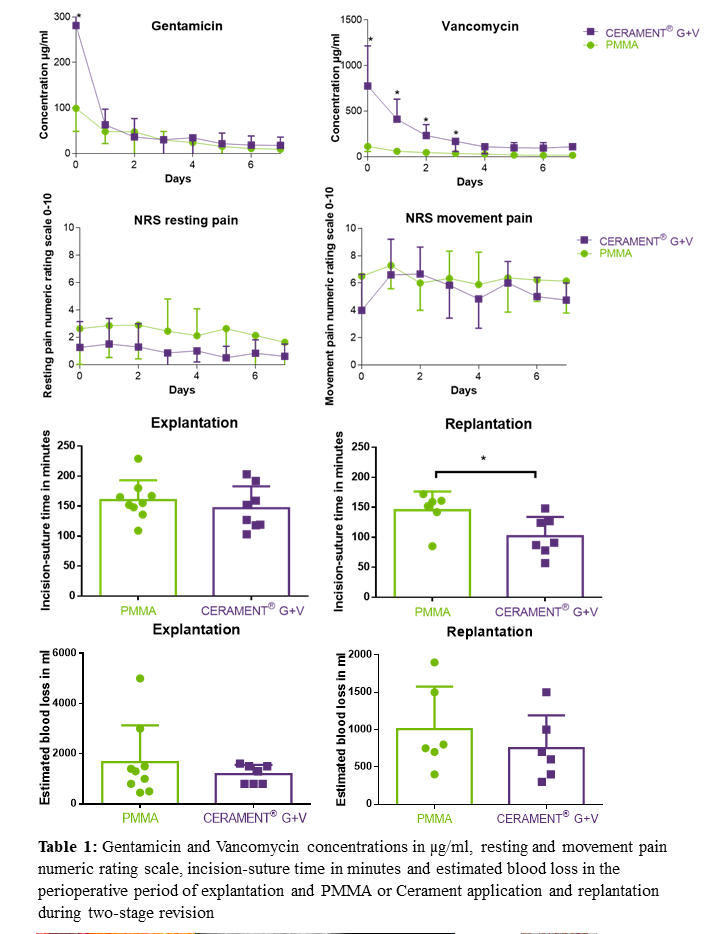
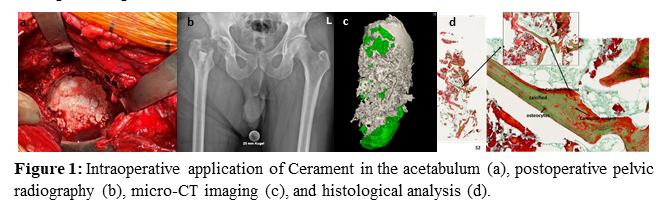
Results: Cerament® V and also G demonstrated sustained high local antibiotic concentrations in the early postoperative period compared to PMMA, with measurable elution over the first seven days. Infection control prior to replantation was achieved. No reinfections occurred within the observed interval in the Cerament® cohort. The biodegradable nature of Cerament® eliminated the need for removal of antibiotic carrier material at replantation, therefore accelerating replantation with reduced blood loss and prevention of mechanical complications of the spacer, such as dislocation or fracture.
Discussion and conclusions: In two-stage revision for PJI, Cerament® G and Cerament® V provide effective local antibiotic delivery with sustained postoperative elution and infection control, enabling dead-space management with a bone substitute. Therefore, biodegradable antibiotic carriers may represent a promising alternative in revision arthroplasty, potentially improving local pharmacokinetics while avoiding the limitations of non-resorbable cement spacers.



