
Deutscher Kongress für Orthopädie und Unfallchirurgie 2026 (DKOU 2026)
A lasting burden: Long-term development of quality of life after successful treatment for periprosthetic joint infection
Text
Objectives and questions: Periprosthetic joint infection (PJI) imposes a profound and enduring burden on patient wellbeing. In 2019, 20,416 cases were treated across Europe, generating an estimated cost of €346,262,026 for healthcare systems. For those affected, recovery extends well beyond microbiological cure to encompass the restitution of mobility, alleviation of pain, and the restoration of quality of life (QoL). The present systematic inquiry evaluated long-term patient-reported QoL after successful treatment of PJI and examined whether outcomes varied according to the anatomical site involved and the therapeutic strategy employed.
Material and methods: A comprehensive search of 3 databases identified studies reporting QoL at least twelve months after surgery. Differences in long-term outcomes by intervention type and joint location were analysed using random effects models. Longitudinal change was evaluated using weighted mean differences across three postoperative time points relative to the preoperative baseline.
Results: 28 studies satisfied the inclusion criteria. No meaningful improvement in QoL was apparent at 3–6 months. By 12 months the physical component score (PCS) rose by 4.74 (SD 2.67, p < .001) and the mental component score (MCS) by 4.08 (SD 3.09, p = .001), with these improvements persisting beyond 24 months or later (Figure 1 [Fig. 1]). Nevertheless, even after one year or more the PCS remained significantly below the US population norm (z = −3.73, p < .001), whereas mental health showed no significant deviation (z = −1.00, p = .32). Pooled estimates were a PCS score of 38.42 (± 2.94) a MCS of 51.44 (± 2.54) and an Oxford Hip or Knee Score of 37.9 (± 4.00) with no significant moderating effect attributable to joint location. Debridement with implant retention (DAIR) was associated with superior mental QoL compared with two-stage revision while differences in physical outcomes were modest. Corresponding pooled estimates were a physical component score of 43.32 (± 3.47) a mental component score of 55.07 (± 2.64) and an Oxford Hip or Knee Score of 39.38 (± 5.29) without statistically significant differences between interventions. Residual heterogeneity was extreme (I² > 95%) and the marked imbalance in study sizes indicates that between study variability outweighed any intervention related effects. Sensitivity analyses supported the robustness of these observations.
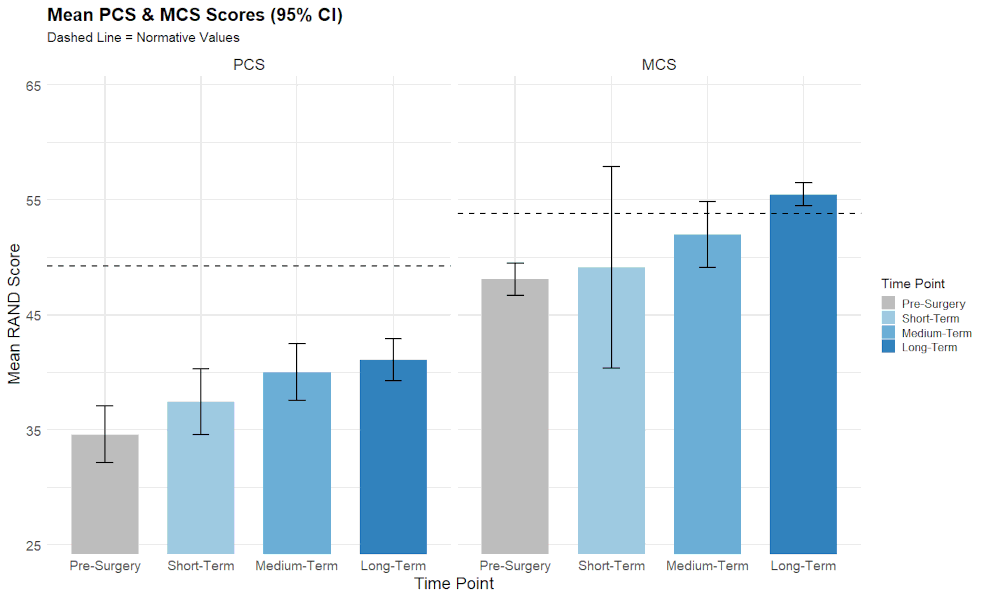
Discussion and conclusions: Patients treated for PJI experience only gradual recovery following successful surgical intervention, and although long-term QoL shows measurable improvement after 12 months, physical health-related QoL commonly remains persistently compromised. The pronounced heterogeneity highlights the multifactorial nature of perceived surgical success. Routine assessment of QoL during follow-up is therefore warranted, and clinicians should account for the possibility of persistent limitations when counselling patients and shaping expectations.



