
Deutscher Kongress für Orthopädie und Unfallchirurgie 2026 (DKOU 2026)
Regenerate fracture after humeral lengthening using a monolateral external fixator in patients with achondroplasia – should prophylactic intramedullary rodding be routinely performed?
Text
Objectives and questions: Bilateral humeral lengthening may improve function and quality of life in patients with achondroplasia (ACH). Due to the specific bone configuration, lengthening is commonly performed with monolateral external fixators (EF). In limb lengthening procedures with an EF, fracture of the regenerate bone is a dreaded complication after hardware removal. In femoral lengthening, fracture rates of up to 30% have been reported. Prophylactic implantation of intramedullary (IM) nails can reliably reduce the fracture rate. In humeral lengthening procedures, prophylactic IM rodding is not routinely performed as it is suspected that the humeral regenerate bone is less prone to fracture due to diminished axial load bearing. Nevertheless, a profound proportion of patients suffer humeral fractures, resulting in pain, unplanned revision surgeries and prolonged treatment time. The aim of this study was to assess the rate of regenerate fracture und investigate whether prophylactic IM rodding should be routinely performed.
Material and methods: Out of a cohort of 107 ACH patients, bilateral humeral lengthening with an EF was performed in 45 patients between 2011–2024. 41 patients fulfilled the inclusion criteria with a minimum follow-up (FU) time of 1 year and were included in the study. Patient charts and radiographs of 82 humeri were retrospectively analysed.
Results: There were 18 girls and 23 boys with a median age at the time of surgery of 8.5 years (IQR 7.7–11.0). The median FU was 6 years (2.5–8.0). The median distraction distance was 92 mm (IQR 88.5–99.5), and the median distraction time was 96 days (IQR 85–104). The median distraction index was 1.0 mm/days (IQR 0.9–1.0), and the median healing index was 0.6 months/cm (IQR 0.6–0.7). The median time with EF was 191 days (IQR 171.5–210.0). Prophylactic IM rodding after EF removal was performed in 11 segments in which the regenerate bone was considered to be at risk for fracture. In 1/11, regenerate fracture occurred despite IM rodding (Figure 1 [Fig. 1]). In total, 13 fractures were observed in 82 lengthened segments (16%) with a median of 7 days (IQR 1.3–14.0) after EF removal. Revision surgery with closed reduction and IM rodding was performed in all but the one humerus in which prophylactic IM rodding had been conducted. IM rods were removed after a median of 3 months (IQR 2.0– 5.0). No surgery-related complications, such as radial nerve damage, were observed after IM rodding or implant removal.
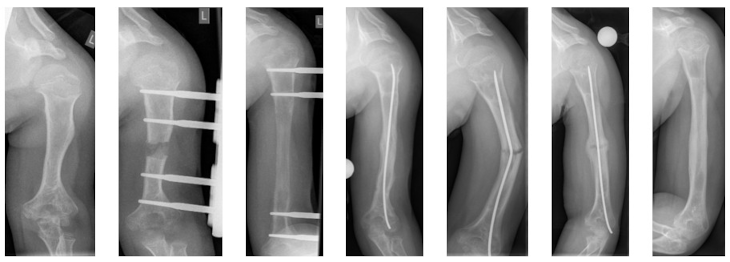
Discussion and conclusions: In limb lengthening in ACH patients, the humerus appears to be less prone for regenerate fracture compared to the lower limb. Considering the lower fracture rate and the disadvantages associated with prophylactic IM nailing (in particular need for additional surgery for implant removal and risk of surgery-related complications), routine IM rodding of the humerus after EF removal appears not to be justified. However, patients should be aware of the potential fracture risk, and carrying of loads should be restricted within the first couple of weeks after EF removal.



