Deutscher Rheumatologiekongress 2026
To identify candidate biomarkers associated with early microvascular changes in VEDOSS and to compare their proteomic profiles with those of patients with SSc and inflammatory controls
Text
Introduction: Very early diagnosis of systemic sclerosis (VEDOSS) identifies patients at risk of progressing to definite systemic sclerosis (SSc), yet the molecular mechanisms underlying this transition remain poorly understood. VEDOSS is characterized by Raynaud’s phenomenon, early capillaroscopic abnormalities, and limited autoantibody positivity, whereas established SSc presents with advanced microvascular damage, fibrosis, and organ involvement. Reliable biomarkers for early vascular damage and disease progression are lacking.
In this cross-sectional study, patients fulfilling VEDOSS criteria and patients with established SSc (ACR/EULAR 2013) were included. Clinical characteristics, nailfold capillaroscopy (early, active, late patterns), autoantibody profiles, and routine laboratory parameters were assessed. Age-matched patients with systemic lupus erythematosus (SLE) and psoriatic arthritis (PsA) served as inflammatory controls. Proteomic profiling was performed using the Olink platform.
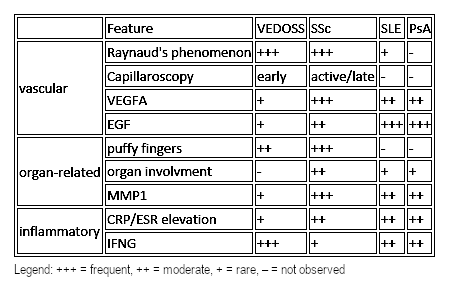
Methods: A total of 15 VEDOSS patients and 30 SSc patients were included, alongside 30 SLE and 30 PsA patients. Raynaud’s phenomenon and puffy fingers were the most frequent features in VEDOSS. ANA positivity was common, whereas SSc-specific autoantibodies were less prevalent compared with SSc. Capillaroscopy predominantly showed early patterns in VEDOSS, while active and late patterns were more frequent in SSc. No organ involvement was observed in VEDOSS, in contrast to SSc.
Results: Proteomic analysis revealed reduced levels of angiogenesis-related factors, including VEGFA and EGF, in VEDOSS compared with SSc, while inflammatory markers were also lower. In contrast, interferon-related activity was markedly increased in VEDOSS compared with SSc and inflammatory controls. Furthermore, levels of matrix metalloproteinase-1 (MMP1) were decreased in VEDOSS, consistent with limited fibrotic activity.
Conclusion: VEDOSS exhibits a distinct molecular profile characterized by reduced angiogenic and fibrotic activity alongside enhanced interferon signaling. These findings suggest that early disease stages are dominated by impaired vascular response and immune activation, preceding the development of fibrosis and organ involvement seen in SSc. The combination of capillaroscopic findings with proteomic markers such as VEGFA, EGF, and MMP1 may improve early risk stratification and monitoring, and interferon-driven pathways may represent potential therapeutic targets to prevent progression.
Disclosures: The authors declare no conflicts of interest.
Table 1 [Tab. 1]
Table 1: Overview of vascular, organ-related, and inflammatory features together with selected proteomic markers in VEDOSS, SSc, SLE, and PsA patients.