
Deutscher Rheumatologiekongress 2026
Six-month real-world outcomes from the UP-RISING study: Patient beliefs in medicines and use of digital health applications in German patients with RA
Text
Introduction: Upadacitinib (UPA) and TNF inhibitors (TNFi) are established therapies for patients with rheumatoid arthritis (RA) [1], [2], [3], [4], [5], [6], while digital health applications (DiGA) are relatively new [7]. The prospective German UP-RISING study evaluates 24-month retention of UPA, TNFi, and DiGA use. This interim analysis reports pooled six-month results.
Methods: Adults with moderate to severe active RA initiating UPA or TNFi per label were enrolled in routine care. Patient reported outcomes included the Rheumatoid Arthritis Impact of Disease (RAID) [8], and disease activity was assessed by DAS28-CRP.
Medication beliefs were assessed at baseline using the general beliefs about medicines questionnaire (BMQ-general) [9]. Pooled outcomes were summarized without between-group comparisons.
Results: 284 patients met the inclusion- and exclusion criteria; 247 received at least one study dose (SAF population), and 245 had at least one follow-up (FAS population; mean age 54.4±13.4 years, 70.2% female, Table 1 [Tab. 1]). At baseline the mean BMQ-general Harm and Overuse sections were 2.2±0.7 and 2.6±0.7 respectively, indicating that most patients did not believe that medicines are broadly harmful or overused by rheumatologists. After 6 months of treatment 66.7% of patients were in DAS28 remission. Patients achieving or missing remission at 6 months had numerically similar beliefs in medicines at baseline as presented in the harm (2.2±0.8 and 2.2±0.6) and overuse (2.4±0.7 and 2.7±0.7) domains of BMQ-general. Patients in DAS28 remission at 6 months had lower RAID values (3.1±1.9) compared to those patients that were not in remission (4.7±2.2), which illustrates that patients benefit in terms of patient-reported outcomes. Thirty-one patients were prescribed a digital health application at baseline, primarily for chronic pain (Figure 1 [Fig. 1]). Thereof, 16 (53.3%) of 30 patients with available data documented at 1 month follow-up visit that they have been using this DiGA since the previous visit. An analysis of the adverse events was implemented for the SAF population, 36.8% reported AEs and 3.6% had SAEs.
Table 1: Baseline demographics of the full analysis set (N=245)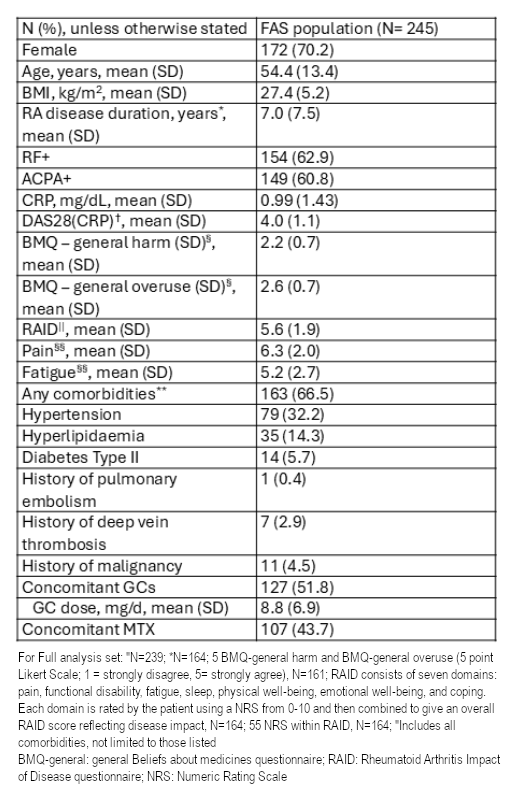
Figure 1: DIGA prescription at BL (N=31)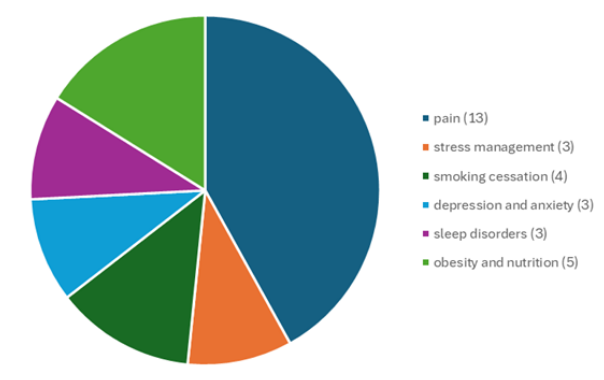
Conclusion: Advanced therapy initiation in routine German practice led to high remission rates and improvement in RAID, with low DIGA use. Medication beliefs at baseline were not associated with DAS28 remission at 6 months. Ongoing follow-up will assess 24-month treatment retention and DiGA outcomes.
Disclosures: Johannes Knitza Consultant of Abbvie, AstraZeneca, BMS, Boehringer Ingelheim, Chugai, GAIA, Galapagos, GSK, Janssen, Eli Lilly, Novartis, Pfizer, Rheumaakademie, Sanofi, Sobi, UCB, Vila Health; Grant/research support from: Abbvie, Alfasigma, Deutsche Rheumastiftung, GSK, Vila Health.
Patrizia Sternad received consulting fees and/or speaker honoria and/or Grant/research support form: AbbVie, Alfasigma, Astra Zeneca, Biogen, BMS, Fresenius, UCB.
Daniel Bestler received speaker honoraria and/or consulting fees and/or Grant/research support from: AbbVie, Alfasigma, AMGEN, Celltrion, Fresenius Kabi, GSK, Eli Lilly, Medac, Novartis, Pfizer, UCB.
Nicolai Steinchen received speaker honoraria and/or travel expenses from: AbbVie, UCB, Eli Lilly, Sandoz, Novartis, AstraZeneca, Fresenius Kabi, Johnson & Johnson.
Sixten Gnuechtel Employee of AbbVie and may own stock or options. Katharina Jeromin Employee of AbbVie and may own stock or options. Franziska Fries Employee of AbbVie and may own stock or options.
Uta Kiltz Consultant and/or speaker honoraria from: AbbVie, Alfasigma, BMS, Chugai, Eli Lilly, Grünenthal, Hexal, Janssen, MSD, Novartis, onkowissen.de, Pfizer, Roche and UCB. Grant/research support from: Abbvie, Amgen, Biogen, Forum, GBA, GSK, Hexal, Fresenius, Novartis und Pfizer and UCB.
Acknowledgements: AbbVie funded this study, contributed to its design, participated in data collection, analysis and interpretation of data, and in writing, review, and approval of the abstract. AbbVie and the authors thank all study investigators for their contributions and all patients that participated in this study. No honoraria or payments were made for authorship. Medical writing was supported by Konrad Goetz (employee of AbbVie). Statistical analysis was provided by StatConsult and was funded by AbbVie.
References
[1] Smolen JS, Pangan AL, Emery P, Rigby W, Tanaka Y, Vargas JI, Zhang Y, Damjanov N, Friedman A, Othman AA, Camp HS, Cohen S. Upadacitinib as monotherapy in patients with active rheumatoid arthritis and inadequate response to methotrexate (SELECT-MONOTHERAPY): a randomised, placebo-controlled, double-blind phase 3 study. Lancet. 2019 Jun 8;393(10188):2303-2311. DOI: 10.1016/S0140-6736(19)30419-2[2] Burmester GR, Kremer JM, Van den Bosch F, Kivitz A, Bessette L, Li Y, Zhou Y, Othman AA, Pangan AL, Camp HS. Safety and efficacy of upadacitinib in patients with rheumatoid arthritis and inadequate response to conventional synthetic disease-modifying anti-rheumatic drugs (SELECT-NEXT): a randomised, double-blind, placebo-controlled phase 3 trial. Lancet. 2018 Jun 23;391(10139):2503-2512. DOI: 10.1016/S0140-6736(18)31115-2
[3] Genovese MC, Fleischmann R, Combe B, Hall S, Rubbert-Roth A, Zhang Y, Zhou Y, Mohamed MF, Meerwein S, Pangan AL. Safety and efficacy of upadacitinib in patients with active rheumatoid arthritis refractory to biologic disease-modifying anti-rheumatic drugs (SELECT-BEYOND): a double-blind, randomised controlled phase 3 trial. Lancet. 2018 Jun 23;391(10139):2513-2524. DOI: 10.1016/S0140-6736(18)31116-4
[4] van Vollenhoven R, Takeuchi T, Pangan AL, Friedman A, Mohamed MF, Chen S, Rischmueller M, Blanco R, Xavier RM, Strand V. Efficacy and Safety of Upadacitinib Monotherapy in Methotrexate-Naive Patients With Moderately-to-Severely Active Rheumatoid Arthritis (SELECT-EARLY): A Multicenter, Multi-Country, Randomized, Double-Blind, Active Comparator-Controlled Trial. Arthritis Rheumatol. 2020 Oct;72(10):1607-1620. DOI: 10.1002/art.41384
[5] Fleischmann R, Pangan AL, Song IH, Mysler E, Bessette L, Peterfy C, Durez P, Ostor AJ, Li Y, Zhou Y, Othman AA, Genovese MC. Upadacitinib Versus Placebo or Adalimumab in Patients With Rheumatoid Arthritis and an Inadequate Response to Methotrexate: Results of a Phase III, Double-Blind, Randomized Controlled Trial. Arthritis Rheumatol. 2019 Nov;71(11):1788-1800. DOI: 10.1002/art.41032
[6] Rubbert-Roth A, Enejosa J, Pangan AL, Haraoui B, Rischmueller M, Khan N, Zhang Y, Martin N, Xavier RM. Trial of Upadacitinib or Abatacept in Rheumatoid Arthritis. N Engl J Med. 2020 Oct 15;383(16):1511-1521. DOI: 10.1056/NEJMoa2008250
[7] Knitza J, Krusche M, Chehab G, Specker C, Richter JG. Digitale Gesundheitsanwendungen – was sollten wir als Rheumatolog:innen wissen [Digital health applications-What we should know as rheumatologists]. Z Rheumatol. 2024 Dec;83(10):859-865. German. DOI: 10.1007/s00393-024-01570-3
[8] Gossec L, Paternotte S, Aanerud GJ, Balanescu A, Boumpas DT, Carmona L, de Wit M, Dijkmans BA, Dougados M, Englbrecht M, Gogus F, Heiberg T, Hernandez C, Kirwan JR, Mola EM, Cerinic MM, Otsa K, Schett G, Scholte-Voshaar M, Sokka T, von Krause G, Wells GA, Kvien TK. Finalisation and validation of the rheumatoid arthritis impact of disease score, a patient-derived composite measure of impact of rheumatoid arthritis: a EULAR initiative. Ann Rheum Dis. 2011 Jun;70(6):935-42. DOI: 10.1136/ard.2010.142901
[9] Tolu S, Rezvani A, Karacan İ, Bugdayci D, Küçük HC, Bucak ÖF, Aydin T. Self-Reported Medication Adherence in Patients With Ankylosing Spondylitis: The Role of Illness Perception and Medication Beliefs. Arch Rheumatol. 2020 Feb 7;35(4):495-505. DOI: 10.46497/ArchRheumatol.2020.7732