
Deutscher Rheumatologiekongress 2026
Rheumatic disease during endocrine therapy for breast cancer: De novo phenotype, treatment patterns, and oncologic outcomes
Text
Introduction: Although endocrine therapy (ET) is a cornerstone of treatment for hormone receptor-positive breast cancer (BC), its side effects regarding rheumatic complications remains incompletely characterized beyond arthralgia and myalgia, as emerging evidence suggests chronic de novo rheumatic condition [1], [2], [3] warranting investigation of their clinical relevance and association with BC outcomes. The aim of this study is to enhance the understanding of rheumatic comorbidities and their influence on the outcome of breast cancer patients with endocrine therapies with a special focus on de novo rheumatic conditions.
Methods: In this retrospective, non-randomized cohort study, 118 ET-treated BC patients with rheumatic and musculoskeletal diseases (RMDs, 70 pre-existing RMDs; 48 de novo RMDs) from the MalheuR project (DRKS00036681) were compared with 905 ET-treated BC controls without RMDs. Event-free survival (EFS) was defined as time from BC treatment initiation until oncological progression (distant metastasis, local recurrence, contralateral carcinoma or BC-related death). Kaplan-Meier analyses, log-rank tests, and Cox regression were performed; stage IV disease was excluded from survival modelling to avoid bias. In a secondary analysis, de novo RMD patients with ET (n=48) were compared with ET-treated BC controls (n=905) as well as de novo RMD patients without ET (n=21).
Results: Median follow up from BC diagnosis was 2,152 days [IQR 1,202–4,593] in patients with RMDs receiving ET and 1,077 days [IQR 310–1,513] in ET-treated controls. Compared with controls, patients with RMDs had higher smoking rates and more early-stage tumors. Despite more frequent ET changes or discontinuations due to toxicity and adverse events, they had longer time to BC-related events and lower event risk (HR = 0.148; 95% CI = 0.076–0.288; p<0.0001).
Patients with de novo RMD under ET (n=48) were younger at BC diagnosis than ET-treated control (51 [44.7–61.75] vs. 58 [49–68] years; p=0.0056), more often premenopausal, and more frequent smokers and showed earlier-stage, lower grade tumors with lower Ki-67 index. Although more oncologic events were recorded over the longer follow-up, time to event and time to death were longer and overall mortality comparable. ET did not affect latency to RMD onset (1,624 [584–3,892] vs. 1,548 [309–5,234] days; p=0.701). Under ET, DMARDs were started more often at first rheumatology consultation (33.3% vs. 9.5%; p=0.0425) and earlier thereafter (75 [20–268] vs. 238 [106–1,203] days; p=0.0272). Although rheumatoid arthritis was the most frequent diagnosis in both groups, ET was associated with a more inflammatory and persistent presentation requiring earlier DMARD initiation, whereas patients without ET more often showed ANCA-associated vasculitis, greater structural joint damage, longer DMARD exposure (Table 1 [Tab. 1]).
Table 1: Characteristics of rheumatic disease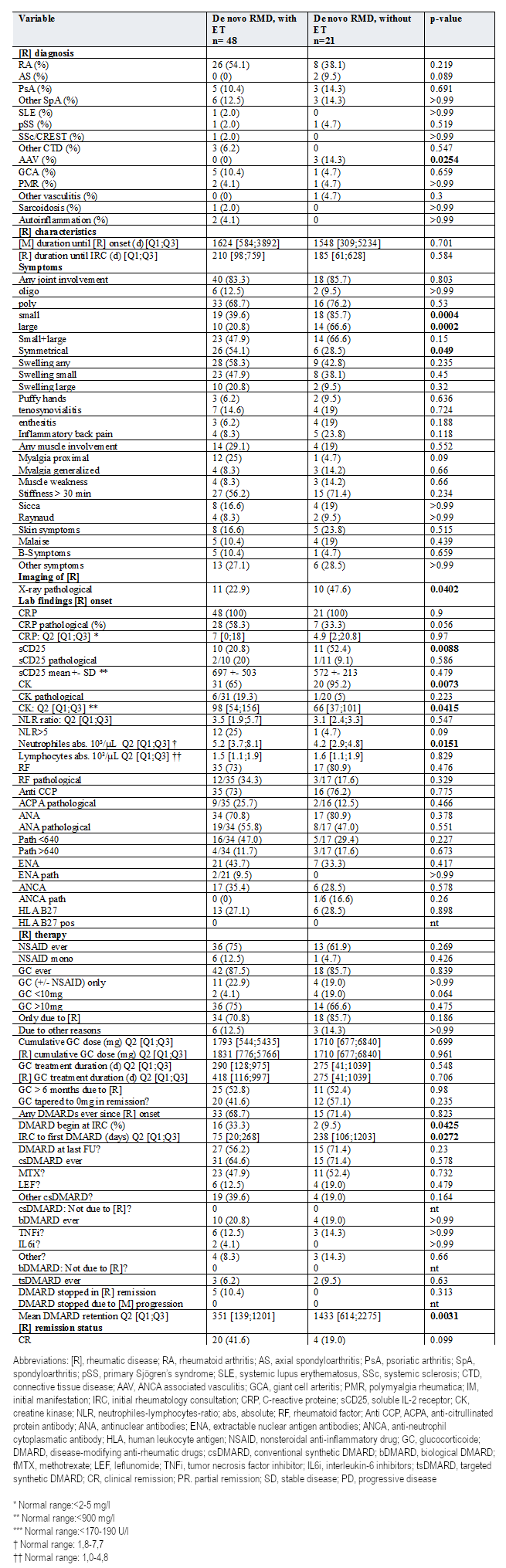
Conclusion: The delayed onset of de novo RMD after initiation of endocrine therapy (ET) suggests that these manifestations may reflect not only early treatment-related toxicity but also longer-term immunologic and/or metabolic effects of hormonal modulation; notably, although affected patients experienced more oncologic events, they had longer times to event and death with similar overall mortality despite longer median follow-up, indicating that clinically relevant rheumatic adverse events during ET, while potentially compromising treatment adherence, may be associated with favorable breast cancer outcomes.
Disclosures: Karolina Gente has received an Exzellenz Stipendium fellowship from the Else Kröner-Fresenius-Stiftung for her research on the coincidence of malignant and rheumatic disorders in the MalheuR project. She has also received grants, research support, and speaker/consulting fees from AbbVie, BMS, Gilead/Galapagos, Janssen, Lilly, Medac, MSD, Novartis, Roche, Sandoz/Hexal, UCB, Viatris.
References
[1] Niravath P. Aromatase inhibitor-induced arthralgia: a review. Ann Oncol. 2013 Jun;24(6):1443-9. DOI: 10.1093/annonc/mdt037[2] Tarhan F, Keser G, Alacacıoğlu A, Akar S. Rheumatological Findings in Patients with Breast Cancer. Eur J Breast Health. 2019 Dec 5;16(1):55-60. DOI: 10.5152/ejbh.2019.5128
[3] Caprioli M, Carrara G, Sakellariou G, Silvagni E, Scirè CA. Influence of aromatase inhibitors therapy on the occurrence of rheumatoid arthritis in women with breast cancer: results from a large population-based study of the Italian Society for Rheumatology. RMD Open. 2017 Sep 28;3(2):e000523. DOI: 10.1136/rmdopen-2017-000523