Deutscher Rheumatologiekongress 2026
Prevalence and clinical characterization of overweight and obesity in psoriatic arthritis: Data from a swiss registry
Text
Introduction: Obesity represents a frequent comorbidity in psoriatic arthritis (PsA), linked to increased disease burden and cardiometabolic risk. Real-world data on the prevalence, clinical characteristics, and socioeconomic determinants of overweight/obesity in PsA patients remain limited in European countries.
Methods: This retrospective, cross-sectional analysis utilized data from the Swiss Clinical Quality Management (SCQM) PsA registry. Adult PsA patients with ≥1 registry visit between January 1, 2017 and December 1, 2025 were eligible. Body mass index (BMI) categories were defined per World Health Organization (WHO) criteria in kg/m²: underweight (<18.5), normal weight (18.5–24.9), overweight (25.0–29.9), and obesity (≥30.0; class I 30.0–34.9, class II 35.0–39.9, class III ≥40.0). Prevalence estimates of BMI categories among PsA patients with 95% confidence intervals (CIs) were calculated descriptively. Associations between overweight/obesity (BMI ≥25 kg/m²) and demographic or sociodemographic characteristics were explored using univariate logistic regression.
Results: A total of 2,087 PsA patients with available BMI data were included. Overall, 36.0% were living with overweight and 27.6% with obesity (class I 18.0%, class II 6.8%, class III 2.9%). Women had a higher prevalence of obesity (28.9% vs. 26.4%) and men of overweight (41.6% vs. 30.7%) (Figure 1 [Fig. 1]).
Figure 1: Baseline prevalence of BMI categories (in kg/m²) among PsA patients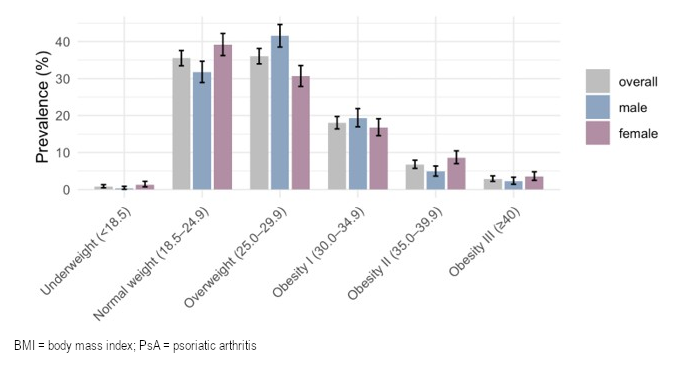
Cardiometabolic comorbidities (cardiovascular disease, type 2 diabetes, hypertension, hyperlipidemia) and depression were more frequent with higher BMI. Disease activity and inflammatory markers increased with higher BMI categories; further clinical characteristics are shown in Table 1 [Tab. 1]. In univariate logistic regression for BMI ≥25 kg/m², increasing age (odds ratio (OR) 1.02; 95% CI 1.01–1.03; p<0.001), male sex (OR 1.44; 95% CI 1.21–1.73; p<0.001), and residence in the Mittelland region (OR 1.58; 95% CI 1.10–2.27; p=0.014) were associated with higher odds of overweight/obesity, whereas tertiary education was inversely associated (OR 0.44; 95% CI 0.31–0.62; p<0.001). Occupation was not significantly associated.
Table 1: Baseline demographic, clinical, and quality of life characteristics among PsA patients living with normal weight (BMI 18.5–24.9 kg/m²), overweight (BMI 25.0–29.9 kg/m²) and obesity (BMI =30.0 kg/m²)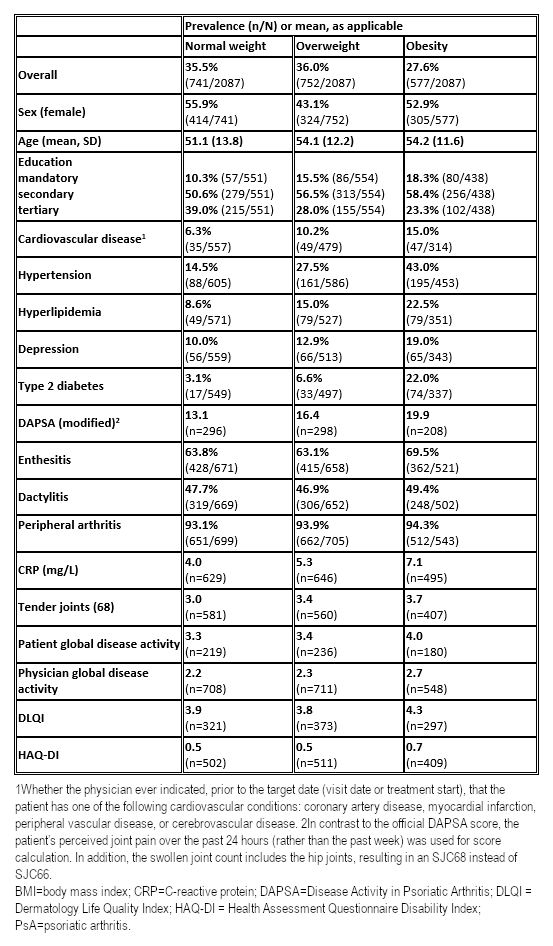
Conclusion: In this Swiss PsA cohort, over 60% were living with overweight (36.0%) or obesity (27.6%), substantially higher than in the general Swiss population (31% and 12%, respectively) [1]. Higher BMI categories were accompanied by greater disease activity, cardiometabolic burden, and depression. These findings underscore the need for weight and comorbidity management in routine PsA care.
Disclosures: Arnaud Monnard and Tatjana Rößler are employees and minor shareholders of Eli Lilly and Company. Michael J. Nissen: Speaker and/or consultancy fees (paid to Institution) from AbbVie, Novartis, Pfizer, Eli Lilly, and Janssen. Burkhard Moeller: Speakers fee, travel reimbursement and advisory board activities from UCB, Novartis. Diego Kyburz: Speaker or consultant: Abbvie, Janssen, Novartis, UCB, Eli-Lilly, Pfizer, Johnson&Johnson. Adrian Ciurea: No conflicts of interest related to this work. Andrea Rubbert-Roth: Speaker and/or consultation fees from Abbvie, Roche, Pfizer, Novartis, Eli Lilly, Janssen, UCB, Sanofi. Claudia Lourenço Rodrigues: No conflicts of interest related to this work. G Tamborrini: No conflicts of interest related to this work. Raphael Micheroli-Konuk: Speaker fees from Eli Lilly, UCB, JnJ and AbbVie.