Logo

Deutscher Rheumatologiekongress 2026

54. Kongress der Deutschen Gesellschaft für Rheumatologie und Klinische Immunologie (DGRh), 36. Jahrestagung der Gesellschaft für Kinder- und Jugendrheumatologie (GKJR), 40. Jahrestagung der Deutschen Gesellschaft für Orthopädische Rheumatologie (DGORh)
09.-12.09.2026
Leipzig

Meeting Abstract

Dual targeted therapy in multi-organ inflammatory disease: Early real-world experience with integrated immunomonitoring

Magdalena Figat - Goethe University Frankfurt, University Medicine, Division of Rheumatology, Frankfurt am Main, Deutschland; Fraunhofer Cluster of Excellence for Immune Mediated Diseases (CIMD), Fraunhofer Institute, Frankfurt am Main, Deutschland; Fraunhofer Institute for Translational Medicine and Pharmacology ITMP, Fraunhofer Institute, Frankfurt am Main, Deutschland
Nikole Radani - Goethe University Frankfurt, University Medicine, Division of Rheumatology, Frankfurt am Main, Deutschland
Ann Christin Bel - Goethe University Frankfurt, University Medicine, Division of Rheumatology, Frankfurt am Main, Deutschland
Maria del Mar Rodriguez Gonzalez - Goethe University Frankfurt, University Medicine, Division of Rheumatology, Frankfurt am Main, Deutschland
Eva Kraimer - Goethe University Frankfurt, University Medicine, Division of Rheumatology, Frankfurt am Main, Deutschland
Michael Teske - Goethe University Frankfurt, Institute of Clinical Pharmacology, Faculty of Medicine, Frankfurt am Main, Deutschland
Robert Gurke - Goethe University Frankfurt, Institute of Clinical Pharmacology, Faculty of Medicine, Frankfurt am Main, Deutschland; Fraunhofer Cluster of Excellence for Immune Mediated Diseases (CIMD), Fraunhofer Institute, Frankfurt am Main, Deutschland; Fraunhofer Institute for Translational Medicine and Pharmacology ITMP, Fraunhofer Institute, Frankfurt am Main, Deutschland
Andreas Weigert - Goethe University Frankfurt, University Medicine, Department of Dermatology, Frankfurt am Main, Deutschland
Irina Blumenstein - Goethe University Frankfurt, University Medicine, Department of Dermatology, Frankfurt am Main, Deutschland; Fraunhofer Cluster of Excellence for Immune Mediated Diseases (CIMD), Fraunhofer Institute, Frankfurt am Main, Deutschland; Fraunhofer Institute for Translational Medicine and Pharmacology ITMP, Fraunhofer Institute, Frankfurt am Main, Deutschland
Alica Kubesch-Grün - Fraunhofer Cluster of Excellence for Immune Mediated Diseases (CIMD), Fraunhofer Institute, Frankfurt am Main, Deutschland; Goethe University Frankfurt, University Medicine, Department of Dermatology, Frankfurt am Main, Deutschland; Fraunhofer Institute for Translational Medicine and Pharmacology ITMP, Fraunhofer Institute, Frankfurt am Main, Deutschland
Andreas Pinter - Goethe University Frankfurt, University Medicine, Department of Dermatology, Frankfurt am Main, Deutschland
Frank Behrens - Goethe University Frankfurt, University Medicine, Division of Rheumatology, Frankfurt am Main, Deutschland; Fraunhofer Cluster of Excellence for Immune Mediated Diseases (CIMD), Fraunhofer Institute, Frankfurt am Main, Deutschland; Fraunhofer Institute for Translational Medicine and Pharmacology ITMP, Fraunhofer Institute, Frankfurt am Main, Deutschland
Michaela Köhm - Fraunhofer Cluster of Excellence for Immune Mediated Diseases (CIMD), Fraunhofer Institute, Frankfurt am Main, Deutschland; Fraunhofer Institute for Translational Medicine and Pharmacology ITMP, Fraunhofer Institute, Frankfurt am Main, Deutschland; Goethe University Frankfurt, University Medicine, Division of Rheumatology, Frankfurt am Main, Deutschland

Text

Introduction: In patients with chronic inflammatory diseases and multi-organ involvement, sequential targeted monotherapy may fail to provide sufficient disease control, while dose escalation can affect immune balance. Dual targeted therapy (DTT) is increasingly used in these refractory cases, yet real-world data on clinical outcomes, safety, and immunological effects are limited. Systematic immune phenotyping is not routinely performed, although it may support infection risk assessment and personalised treatment decisions.

Objectives: To characterise indications, treatment patterns and early safety outcomes of patients receiving DTT in a real-world, interdisciplinary setting, and to evaluate the feasibility of integrating longitudinal FACS-based immunomonitoring into routine care.

Methods: Patients with at least two clinically relevant inflammatory manifestations receiving DTT (bDMARD + bDMARD or bDMARD + JAK/TYK2 inhibitor) were prospectively enrolled. Standardised follow-up included disease activity, infection frequency and clinical response. Immunomonitoring comprised flow cytometry of B- and T-cell subsets and immunoglobulin levels. Patients are followed every 3–4 months with repeated clinical and immunological assessments within a rheumatology–dermatology–gastroenterology care pathway.

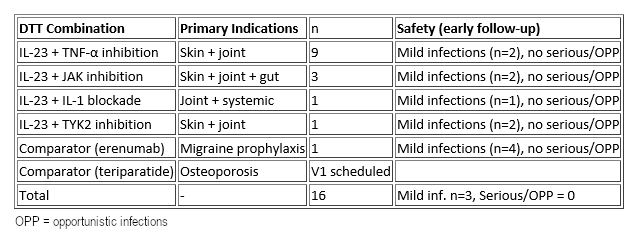
Results: To date, 35 patients have been enrolled; 16 completed Visit 1 and two Visit 2. Most presented combined articular–cutaneous, articular–gut, or joint–skin–gut manifestations. The most frequent DTT regimens were IL-23 + TNF-α inhibition (n=9) and IL-23 + JAK inhibition (n=3). Additional combinations included IL-23 + IL-1 blockade and IL-23 + TYK2 inhibition. Patients receiving combination of bDMARDs and erenumab or teriparatide served as internal comparators due to minimal expected immunological effects. No serious or opportunistic infections occurred; mild infections were outpatient-managed. FACS-based immunophenotyping was feasible in all cases. Initial results indicated divergent effects on T-cell counts depending on the DTT combination (increase under IL-23 + TNF-α; decrease under IL-23 + JAK). Changes in monocyte counts may reflect ongoing inflammatory activity. Longitudinal data collection is ongoing.

Conclusion: DTT represents an important therapeutic strategy for refractory multi-organ inflammatory disease. The study demonstrates that structured immunomonitoring can be successfully implemented and may help characterise safety and immune changes under DTT. Early observations show measurable alterations in immune cell subsets without corresponding increases in infection risk. This integrated approach offers a basis for future work on personalised immunomodulation and risk stratification.

Disclosures: The authors declare no conflicts of interest.

Figure 1[Fig. 1]

Figure 1: Treatment course and immunostatus alternation
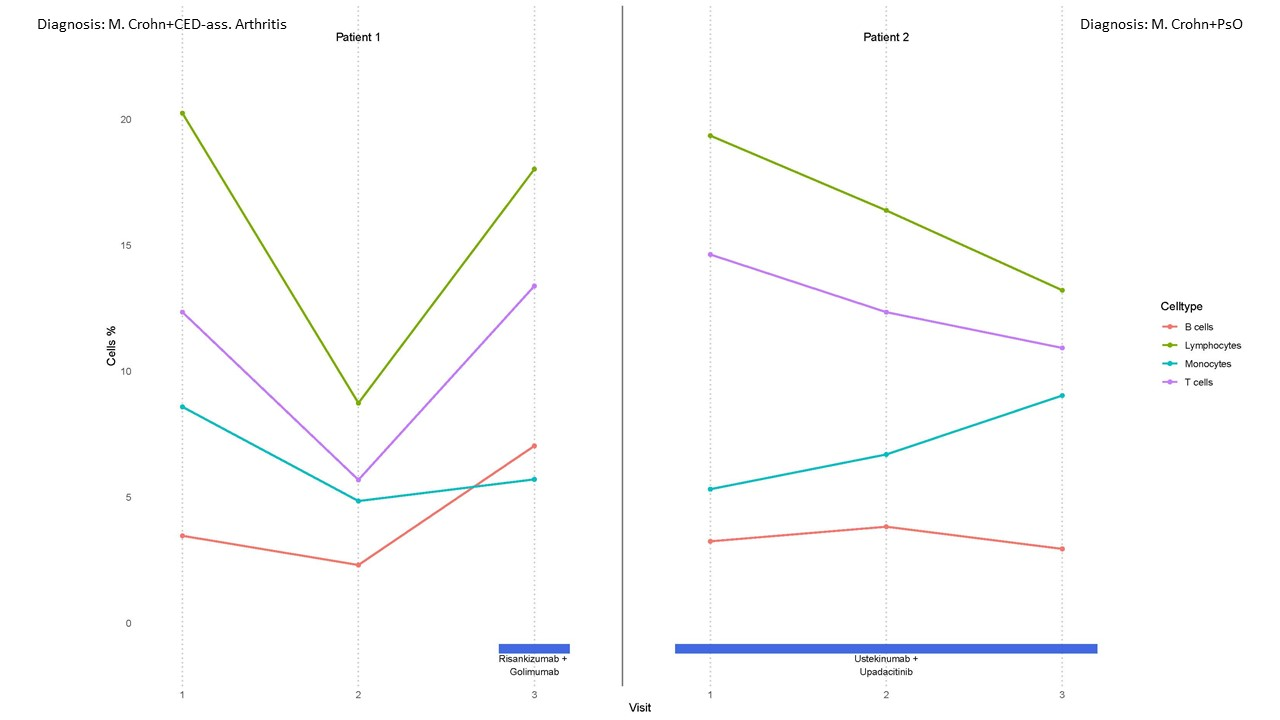
Table 1 [Tab. 1]

Table 1: Treatment combinations, indications and early safety observations in the DTT cohort