
42. Wissenschaftliche Jahrestagung der Deutschen Gesellschaft für Phoniatrie und Pädaudiologie (DGPP)
Multimodal measurements of fluid-structure-acoustic interaction in an ex-vivo full-larynx model
Abstract
Background: Fully understanding voice production process requires detailed analysis of the interaction between airflow, vocal fold vibrations, and acoustics, referred in engineering to as fluid-structure-acoustic interaction (FSAI). Experimental studies using ex-vivo cadaver larynx models provide unique physiologically relevant insights that cannot be obtained in in-vivo settings. However, their application remains limited due to demanding experimental conditions (complex setups, the need for consistent larynx preparation, and strict time constraints imposed by tissue viability) often leading to variable outcomes. This study presents a standardized and automated experimental approach for multimodal measurements in ex-vivo full-larynx models, enabling systematic investigation of underlying FSAI mechanisms.
Materials and methods: Experiments were conducted on ex-vivo full-larynx models under various phonatory conditions. A custom automated framework was used to systematically control relevant parameters and to acquire multiple measurement modalities simultaneously, including high-speed imaging, acoustic recordings, sub- and supraglottal pressure measurements. In addition, particle image velocimetry (PIV) was applied to acquire the 2D supraglottal flow filed patterns during vocal fold vibration.
Results: Simultaneous measurements enabled temporally aligned analysis of acoustic, subglottal, and supraglottal pressure signals within individual phonatory cycles. PIV resolved time-dependent supraglottal airflow dynamics, allowing visualization of flow evolution in relation to the recorded signals. Top-view high-speed imaging captured superior vocal fold motion, providing complementary insight into glottal dynamics. Together, these modalities yielded a detailed characterisation of FSAI during ex-vivo phonation.
Conclusion: The applied approach enables systematic and reproducible investigation of FSAI in ex-vivo full-larynx models. It allows acquisition of high-resolution, temporally aligned data under controlled experimental conditions. The results highlight the value and role of synchronized multimodal measurements. In particular, the dataset provides a basis for more detailed analysis of phonatory processes and serves as a reference for the validation and refinement of computational voice production models.
Text
Background
Fully understanding the voice production process requires detailed analysis of the interaction between airflow, vocal fold vibrations, and acoustics, referred to in engineering as fluid-structure-acoustic interaction (FSAI). Experimental studies using ex-vivo cadaver larynx models provide unique physiologically relevant insights that cannot be obtained in in-vivo settings [1]. However, their application remains limited due to demanding experimental conditions (complex setups, the need for consistent larynx preparation, and strict time constraints imposed by tissue viability) often leading to variable outcomes. This study presents a standardized and automated experimental approach for multimodal measurements in ex-vivo full-larynx models, enabling systematic investigation of underlying FSAI mechanisms.
Materials and methods
Experiments were conducted on ex-vivo full-larynx models under various phonatory conditions using the experimental setup shown in Figure 1 [Fig. 1]. A custom automated framework [2] was used to systematically control relevant parameters and to acquire multiple measurement modalities simultaneously, including high-speed imaging, acoustic recordings, sub- and supraglottal pressure measurements. In addition, particle image velocimetry (PIV) was applied to acquire the 2D supraglottal flow field patterns during vocal fold vibration.
Figure 1: Schematic overview of the experimental setup, including the ex-vivo larynx model, data acquisition system, high-speed cameras, microphones, pressure sensors, flow control system and laser-based PIV system for supraglottal flow measurements.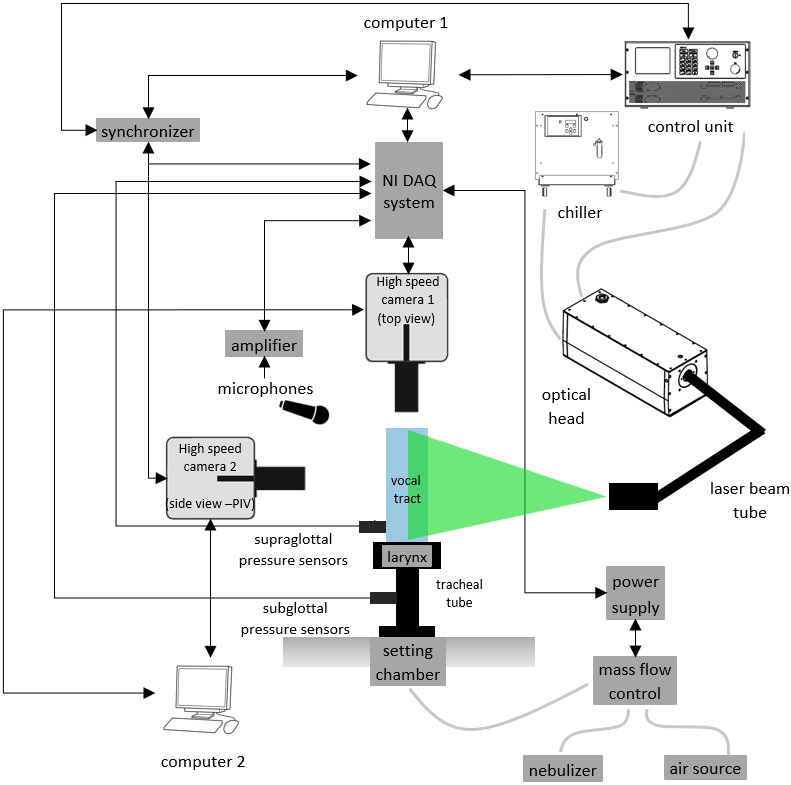
Results
Simultaneous measurements enabled temporally aligned analysis of acoustic, subglottal, and supraglottal pressure signals within individual phonatory cycles. PIV resolved time-dependent supraglottal airflow dynamics, allowing visualization of flow evolution in relation to the recorded signals. Top-view high-speed imaging captured superior vocal fold motion, providing complementary insight into glottal dynamics. Together, these modalities yielded a detailed characterisation of FSAI during ex-vivo phonation (Figure 2 [Fig. 2]).
Figure 2: Representative data illustrating FSAI during ex-vivo phonation. (a) Supraglottal and subglottal pressure signals and audio; (b) top-view high-speed imaging of vocal folds and the corresponding glottal area waveform; (c) side-view high-speed imaging with the corresponding PIV-derived supraglottal flow velocity magnitude.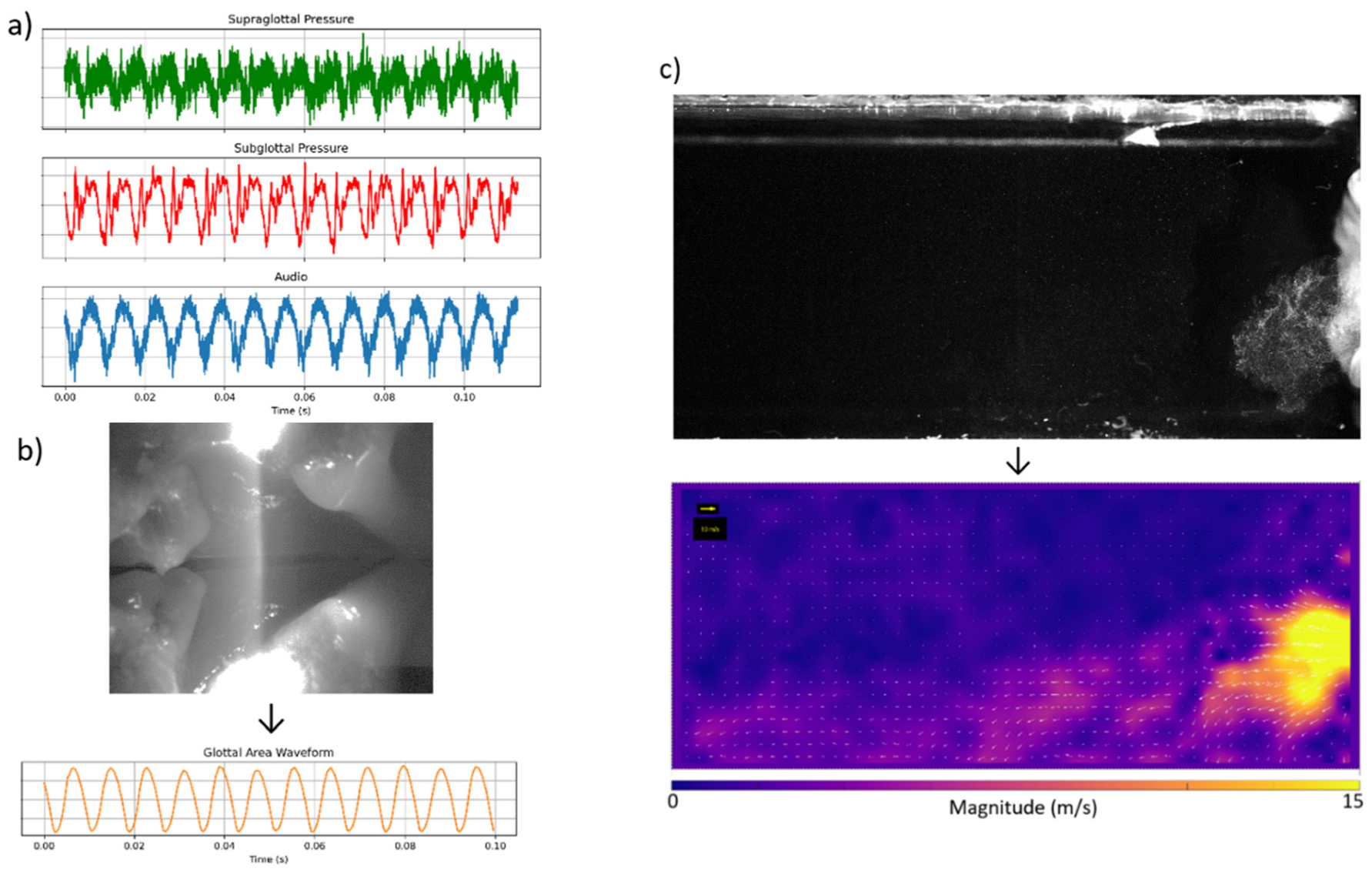
Conclusions
The applied approach enables systematic and reproducible investigation of FSAI in ex-vivo full-larynx models. It allows acquisition of high-resolution, temporally aligned data under controlled experimental conditions. The results highlight the value and role of synchronized multimodal measurements. In particular, the dataset provides a basis for more detailed analysis of phonatory processes and serves as a reference for the validation and refinement of computational voice production models.
References
[1] Döllinger M, Kobler J, Berry DA, Mehta DD, Luegmair G, Bohr C. Experiments on Analysing Voice Production: Excised (Human, Animal) and In Vivo (Animal) Approaches. Curr Bioinform. 2011;6(3):286-304. DOI: 10.2174/157489311796904673[2] Vulic H, Kniesburges S, Tur B, Wang R, Döllinger M. An Automated and Modular Framework for Synthetic and Ex-vivo Larynx Experiments. In: The Voice Foundation's 55th Annual Symposium: Care of the Professional Voice; 2026 May 27-31; Philadelphia, PA, USA.