
Künstliche Intelligenz: Die digitale Zukunft in der Pflege gestalten. 9. Fachtagung Technik – Ethik – Gesundheit
ADMIRE – an analytic tool for orientation in digitalized living environments
Text
1 Introduction
When constructing responsible, consumer-oriented technical systems, an enormous amount of knowledge and methods is necessary in order to succeed. When reflecting on the forms of expertise needed, we often consider explicit forms of knowledge originating from different disciplinary backgrounds. Research modes like Responsible Research and Innovation (RRI) and ELSI (Ethical, Legal and Social Implications) stress the importance of broadening the technical perspective by considering non-technical perspectives equally relevant for successful implementation. By including the reflection of non-technical preconditions and effects of technological systems, an important step towards an ethically, legally and socially responsible form of technological construction was made. However, these research modes often focus on explicit forms of knowledge, which can be detected in codes of law or by conducting surveys, but simultaneously underestimate the meaning of implicit forms of knowledge. The reflected objectives, models and rules that consciously and explicitly guide the development process of technical systems are complemented by implicit, unconscious assumptions about users, interaction and the relationship between humans and technology, which are unreflected but not ineffective. Both conscious and unconscious ideas guide technological development and usage processes by orientating people’s actions, thoughts and feelings and thus influencing the interpretation of the interaction situation and the selection of a suitable behavior. These implicit ideas about humans (conceptions of humans – Menschenbilder) and technology (technical imaginaries – Technikbilder) therefore indirectly influence the interaction between users and the developed technology and thus determine its success or failure. In a broader sense and beyond considering concrete interactions only, these ideas also affect technology in its mediality and gradually change the interacting individuals’ relationship to themselves. The same counts vice versa: the deployment of technology impacts on the human’s perception of interaction, why it is necessary and how it should work.
In order to avoid mismatches between the implicit ideas of developing engineers and users, which can lead to failure regarding implementation, it is necessary to reflect systematically and explicitly upon these implicit conceptions.
2 ADMIRE – an analytic tool
In order to cope with potential mismatches before and during the development process, it is necessary to explicate these implicit conceptions of humans and technical imaginaries. This allows these assumptions to be reflected against the background of the development and implementation context of the technology and their concrete effects on human-machine interaction as well as the human-machine relationship to be shown.
For this purpose, we developed ADMIRE (Analyse Digitaler Mensch-Maschine Interaktion & RElation) an analytical tool that is intended to enable a structured reflection process for all those involved in R&D. It has a low barrier on methodological prerequisites and does not require specific prior disciplinary knowledge. It helps clarifying the (pre-)orientations regarding humans and machines that are introduced into the development process by means of explicating them. Human-machine interaction can not only be understood in its current situatedness and thus from the present, but is always also made possible by a past in the context of which orientations (in the sense of assumptions, judgments and behavioral patterns) about human-technology relationships were acquired. The acquired orientation influences the perception, the emotional and rational interpretation of the situation as well as the behaviour in the concrete interaction situation and can only be identified through targeted analysis. This form of analysis is currently not carried out systematically within the framework of technology development projects, as these usually have a selective focus on the interaction situations to be constructed, which are viewed in isolation from historical, social and cultural background and their preconditions. In addition to an orientation function, ADMIRE also offers the potential to recognize and avoid inadmissible, discursive fallacies through the act of reflection. It is to be understood as a tool for gaining knowledge, i.e. its methodology does not prescribe normative states, but is rather descriptive of the human-technology relationship.
With regard to integrated technology development, ADMIRE offers the options of both (1) reconstructing ex post conceptions of humans and machines by those who developed existing technical systems, and (2) identifying and constructively addressing the corresponding implications ex ante as part of the planning and implementation of projects. The effects of conceptions of humans and machines on interaction partners, technical systems and the human-technology relationship, are thus accessible to both designers and third parties.
ADMIRE (see Figure 1 [Abb. 1]) is easily accessible in both the technical and non-technical areas by making use of a central concept of technology development, the so-called use case diagram. This is a graphical tool in software and technology development to represent the interactions of a technical system with its users in a structured manner, where these users can be humans or other technical systems. The use-case diagram is easy to understand even without prior technical knowledge, it should be known to those with (software) technical training as part of the standard UML (unified modeling language), and it is ideally placed at the interface between human and machine in order to enable the professional-cultural transition between the spheres of non-technical reflection on the preconditions of interactions and the technical realization of concrete artefacts. It, thereby, attempts to operationalize a structured reflection about the implicit preconditions of technological development in a way that is easily accessible to all those involved and is linked to the specific technical system.
Figure 1: ADMIRE – an analytic tool for orientation in digitalized living environments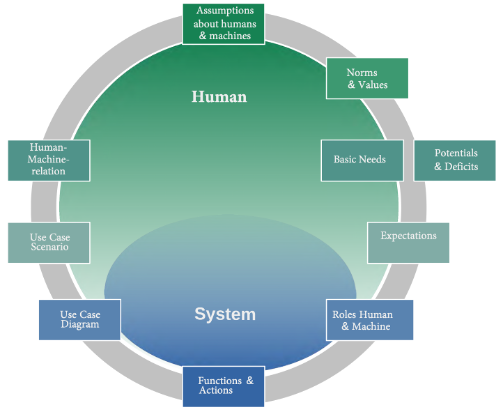
(Manzeschke/Steil/Assadi/Wehrle)
The proposed analytical tool is applied in form of a guided workshop with developers and system designers. In the course of the workshop, the “boxes” in Figure 1 [Abb. 1] are discussed at hand of respective structured questions in order to explicate the implicit conceptions about humans and machine. In the following we describe the different steps in a rather general manner. The starting point of the analysis tool is the “Human-machine Relation”. This relation is examined and described in more detail using some theory-based constructs that are useful for understanding the interaction between humans and technology. After the relationship has been examined against the background of these constructs, it is possible to derive a clearer understanding of images of humans and machines that have an effect on the human-machine relationship.
The human-machine relationship is put in concrete terms in the “Use Case Scenario” and can therefore be analyzed further. The latter explains the application context of the technology to be developed as well as the intended objective of the human-technology interaction. Such a scenario is usually required in project and research proposals, which is why it offers a low-threshold and connectable concretization for reflecting on and defining the human-machine relationship.
The use case scenario enables the transition to the technical level, which is substantiated in the form of a Use Case Diagram. It contains a formal description of how the technology works in relation to various actors, including humans. Functions, Actions and their hierarchies are defined. The use case diagram also indicates which roles the various actors have in the human-machine relationship and whether and which interactions occur between them.
The use case diagram is compatible with the social science and philosophical construct of complementary “Roles of Humans and Machines”, the exercise of which in a specific interaction situation reduces complexity, creates certainty of expectations and actions, stabilizes order and thus offers orientation. On the human side, roles are linked to behavioral expectations, patterns of thinking and action, thoughts and feelings. By referring to (social and technical) roles, expectations of the behavior, feelings and thoughts of humans and the behavior of machines can be described, which creates a practical approach to render abstract and universalizing images of humans and machines concrete and analyzable. This concretization allows elements of the human and machine conception as well as the relationship between the two to be analyzed.
Roles and the Expectations connected to roles can be linked to the Potentials and Needs of the role holders. In addition to potentials, Deficits associated with the respective assigned role can also be derived. The potentials and deficits that are linked to the roles of humans and machines in turn allow conclusions to be drawn about the norms that are linked to them and articulated in them. Behavioral Norms formulate the rules that are linked to holding a role and in turn articulate and refer to abstract Values such as freedom, justice, equality, etc.). Access via norms and values also enables reflection on the context of the respective interaction, since both norms and values always refer to a specific historical and social scope.
Furthermore, roles and the patterns of interpretation and action associated with them, as well as expectations, can be understood from a psychological and anthropological perspective not only as normative constructs in the service of reducing complexity and providing orientation, but also as a socially established and legitimate form of response to human needs. Humans can therefore be understood not only as beings that can be characterized by potentials (e.g. autonomy) and deficits, but also as beings that are characterized by Needs. Structurally analogous to the discussion of human needs, functional requirements can be identified on the technical side, the fulfillment of which must be ensured for the interaction to succeed. Depending on the type and amount of needs satisfied by the roles in the human-machine relationship, different values can then be inferred.
With the help of the Norms and Values that are linked to humans and machines, the question can finally be raised as to how people are viewed in the human-machine relationship. The answers to this question explicate possible conceptions of humans in the relationship and serve as a basis for reflection.
3 Methodology
The methodological approach consists in constructing and using a tool that contains various elements that build on one another but can also be considered separately. Abductions are used to draw conclusions from one element to another. Abductions are functional for ADMIRE, even if they are not strictly speaking logically valid. Due to the implicit and unconscious nature of conceptions of humans and machines and the fact that they have (so far) mostly been lacking in analysis, it is impossible to have the conceptions that are actually effective in the construction available, or to reconstruct them ex post deductively. The direction in which the analytic instrument is run through, as well as the number of elements to be considered in it, is not conclusively determined. However, the probability of discussion fallacies or false conclusions increases the more constructs of the analytic tool are not considered. Extensions or modifications are always conceivable and feasible, which means that the tool can be adapted to the respective context.
4 Conclusions
The analysis tool was evaluated by relevant experts and validated in a small number of initial test workshops. Our early experience is that the analysis of implicit images of humans and machines succeeded, on the one hand, to establish a more differentiated and more accurate idea of the human-machine relationship to be constructed. On the other hand, this enables a new connection between technology-anthropological reflection and ethical evaluation, which beyond enriching the technical perspective with non-technical aspects, also makes anthropological foundations of ethical judgments identifiable and accessible for reflection and deliberation. The analysis tool thus addresses a gap, both in the connection between technical and anthropological expertise and in the connection between anthropological and ethical reflection.
Funding
The authors state funding from the German Ministry of Education and Research (FKZ: 16SV8626).