Deutscher Rheumatologiekongress 2026
The Rheumatology Escape Room at EULAR congress 2025 – quality assessment of a modern teaching approach
Text
Introduction: Contemporary medical education increasingly emphasizes applied learning, critical thinking, and learner-centered, interactive formats. Escape Rooms, team-based scenarios requiring collaborative problem-solving, have emerged as innovative educational tools. In medical education, they can foster both technical and non-technical competencies, including clinical reasoning, communication, teamwork, and creative thinking. Building on prior work demonstrating their value in rheumatology education, we developed a specialized Escape Room to deliver core content in an engaging, application-oriented format. To evaluate knowledge acquisition among participants of a rheumatology Escape Room conducted at the EULAR Congress 2025.
Methods: At the EULAR Congress 2025 in Barcelona, a rheumatology-themed Escape Room covering key clinical topics and multiple difficulty levels was offered. Each 90-minute session included a 15-minute introduction and was conducted 14 times. Participation was open to all attendees without eligibility criteria, with on-site registration. Participants solved puzzles requiring application of rheumatological knowledge, analytical reasoning, and teamwork, addressing disease mechanisms, therapeutic principles, and assessment tools. Knowledge acquisition was assessed using a 10-item questionnaire administered immediately before and after participation via an online survey. Changes in performance were analyzed using descriptive statistics and paired t-tests (SPSS v29).
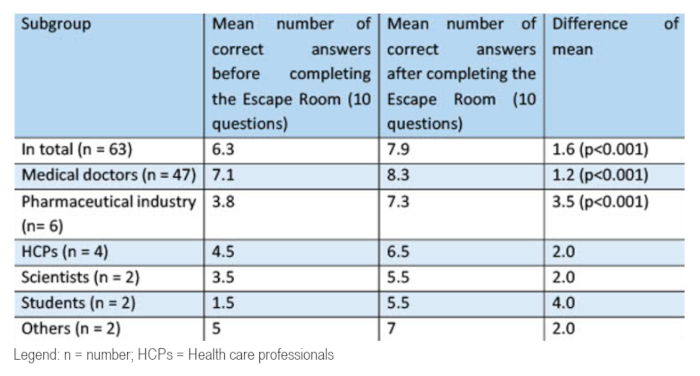
Results: Sixty-three participants from 19 countries were included (mean age 37 years [range 27–63], 69.8% female). Professional backgrounds comprised medical doctors (74.3%), pharmaceutical industry representatives (9.5%), healthcare professionals (6.3%), basic scientists (3.2%), students (3.2%), and others (3.2%). The mean number of correct responses increased from 6.3/10 (SD 2.2) pre-intervention to 7.9/10 (SD 1.7) post-intervention (p < 0.001), indicating a significant overall knowledge gain. Improvements were observed across all professional groups.
Conclusion: The rheumatology Escape Room is a well-received and effective complement to traditional educational formats, offering an engaging, team-based learning environment. Participants demonstrated significant short-term knowledge gains across diverse professional backgrounds, suggesting that this approach is inclusive and suitable for learners with heterogeneous baseline expertise.
Disclosure of interest: None declared
Table 1 [Tab. 1]
Table 1: Number of correct answers (out of 10) before and after Escape Room (mean values)