
Deutscher Rheumatologiekongress 2026
Multi-omics profiling and machine learning identify dual homeostatic defects in recurrence of giant cell arteritis
Text
Introduction: The relapse rate of giant cell arteritis (GCA) remains a major clinical challenge [1], largely due to an incomplete understanding of the mechanisms driving the failure of immune homeostasis. While the acute inflammatory response is well-characterized [1], the precise molecular defects preventing the termination of pathogenic signaling are undefined.
Methods: To delineate the hierarchical molecular layers of homeostatic failure, high-resolution proteomics and bulk RNA sequencing were performed on peripheral blood mononuclear cells (PBMCs) and serum from participants, including treatment-naïve, drug-free remission, and relapsing GCA patients, alongside matched healthy controls. Functional ex vivo assays and supervised machine learning algorithms were utilized to validate pathway dysregulation.
Results: Active GCA is characterized by systemic saturation of serum amyloid A (SAA) (Figure 1a [Fig. 1]) and transcriptional dysregulation of the formyl peptide receptor 2 (FPR2) [2] (Figure 1b [Fig. 1]). RNA sequencing revealed that this transcript dysregulation is driven by a disease specific FPR2 bias, resulting in a loss of surface receptor responsiveness. Upon SAA re-exposure in remission PBMCs displayed an explosive 32-fold upregulation of interleukin (IL)-23 compared to active disease (Figure 1c [Fig. 1]). Furthermore, while clinical remission restores FPR2 receptor functionality, it fails to correct a persistent defect in the suppressor of cytokine signaling 3 (SOCS3) intracellular checkpoint (Figure 1d [Fig. 1]). Treatment with the FPR2 agonist successfully suppressed pathogenic IL-23 secretion in remission but failed in the refractory active disease state (Figure 1e [Fig. 1]). Lastly, machine learning approach confirmed that clinical recurrence is a highly accurate molecular recapitulation of the primary disease state, driven by the re-engagement of SAA in a homeostatically incompetent environment.
Figure 1: The serum amyloid A-formyl peptide receptor 2 axis in giant cell arteritis. (a) Differential expression of serum amyloid A isoforms in patient serum across disease phases. (b) Transcriptional upregulation of the resolution receptor formyl peptide receptor 2 in active disease. (c) Paradoxical interleukin-23 fold change induction following serum amyloid A stimulation in different disease stages. (d) Defective induction of the suppressor of cytokine signaling 3 in remission cohort. (e) The formyl peptide receptor 2 agonist effect on interleukin-23 protein secretion in remission state.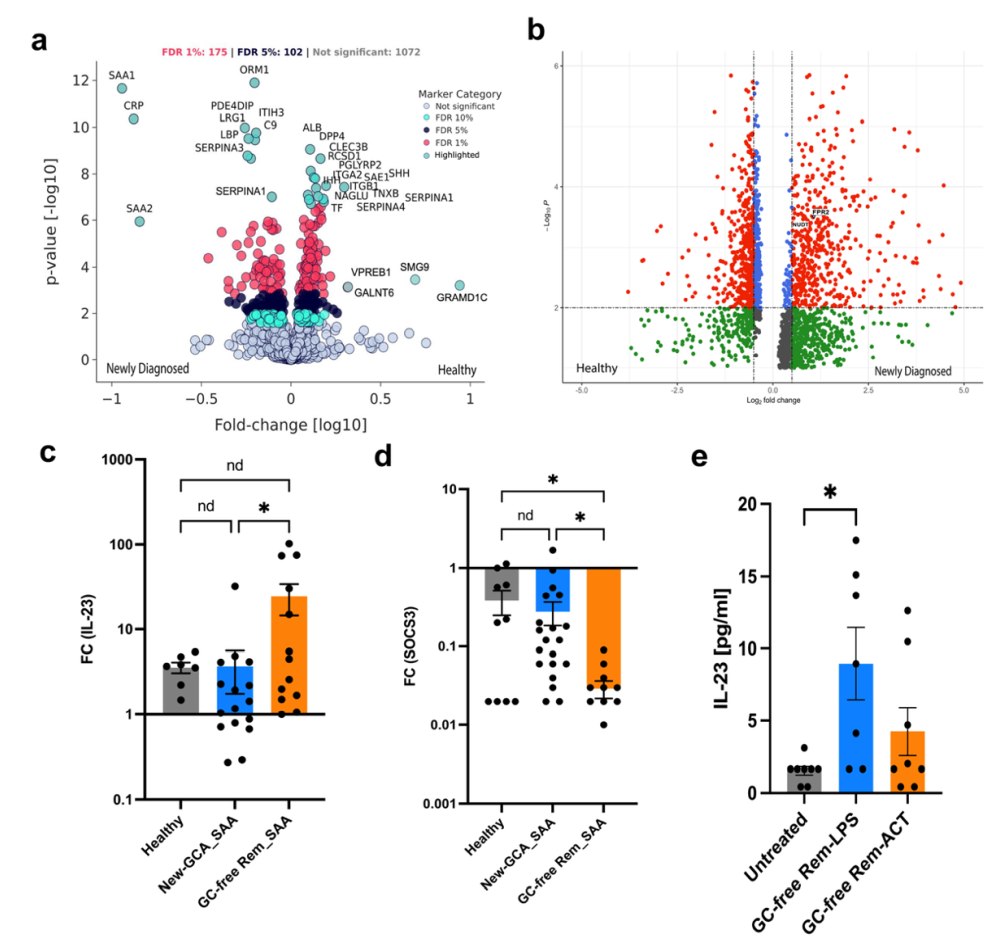
Conclusion: During active GCA pathogenic IL-23 upregulation is driven by dual homeostatic defects and intracellular SOCS3 signaling failure. These findings establish that durable clinical remission requires the active restoration of homeostatic signaling competence rather than broad immunosuppression alone.
Literatur
[1] Bilton EJ, Mollan SP. Giant cell arteritis: reviewing the advancing diagnostics and management. Eye (Lond). 2023 Aug;37(12):2365-2373. DOI: 10.1038/s41433-023-02433-y[2] Mastromarino M, Lacivita E, Colabufo NA, Leopoldo M. G-Protein Coupled Receptors Involved in the Resolution of Inflammation: Ligands and Therapeutic Perspectives. Mini Rev Med Chem. 2020;20(20):2090-2103. DOI: 10.2174/1389557520666200719014433