
Deutscher Rheumatologiekongress 2026
Soluble immune complexes induce inflammation and immune escape in pulmonary fibroblasts via innate immune cell activation in anti-Scl70+ systemic sclerosis
Text
Introduction: We have previously shown that the potential of soluble immune complexes (sICs) to activate Fcy-receptors such as CD16 on Natural Killer (NK) cells is linked to interstitial lung disease (ILD) in anti-Scl70 positive Systemic Sclerosis (SSc). We have also shown that HLA-E expression on senescent fibroblasts mediates their immune escape and accumulation in fibrosis.
Here we investigated the link between autoimmunity, sICs, NK cells and fibroblast pathology.
Methods: sICs in sera were detected using a novel reporter cell assay that quantifies sICs by their ability to engage Fcy-receptors (“bioactivity”). “Neo-sICs” were generated by adding recombinant Scl70 antigen to sera from anti-Scl70 positive SSc patients. The effect of Neo-sICs on PBMCs and NK cells in mono- as wells as coculture with primary pulmonary fibroblasts was analyzed by flow cytometry.
Results: We observed a significantly higher sIC bioactivity in anti-Scl70 positive SSc sera compared to anti-Scl70 negative SSc and healthy control sera. In anti-Scl70 positive sera sIC bioactivity was further enhanced by addition of Scl70 antigen. In healthy PBMCs these “Neo-sICs” activated Fcγ receptor bearing monocytes and NK cells and caused functional degranulation (Figure 1 (A) [Fig. 1]) and release of IFN-y by NK cells. Incubation with NK cell-derived IFN-y or co-culture with sIC-activated NK cells induced an inflammatory phenotype in primary pulmonary fibroblasts and upregulated the NK cell inhibiting ligand HLA-E.
Figure 1: (A) Anti-Scl70 specific sICs induce activation and degranulation of NK cells in serum from anti-Scl70 pos. SSc patients (B) sIC-activated NK cells release IFN-y and induce inflammation (HLA-ABC and HLA-DR upregulation) and immune escape (HLA-E upregulation) in pulmonary fibroblasts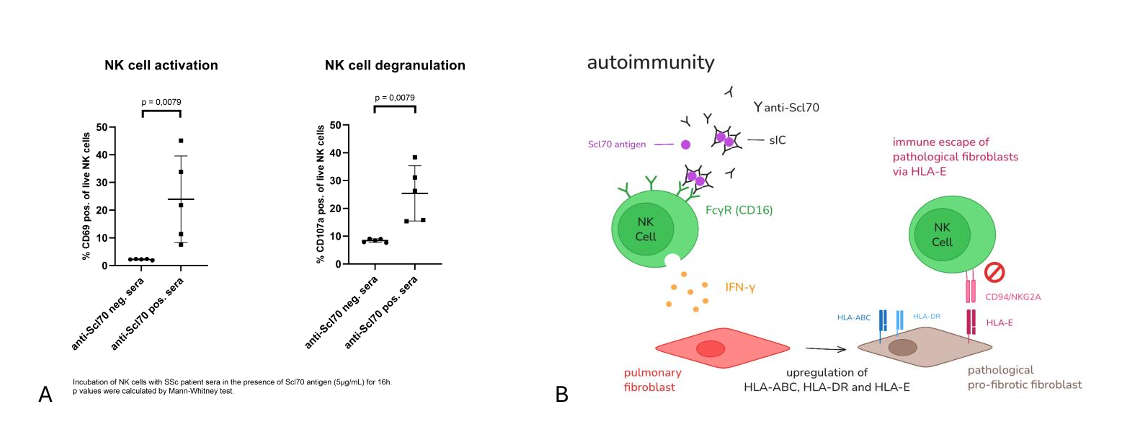
Conclusion: Our results link Scl70-specific sICs and fibroblast pathology via activation of NK cells. NK cell activity and release of IFN-y have a bifold pro-fibrotic effect on fibroblasts by inducing an inflammatory phenotype and upregulating HLA-E, thus reducing their susceptibility to immune clearance (Figure 1 (B) [Fig. 1]).