
Deutscher Kongress für Orthopädie und Unfallchirurgie 2026 (DKOU 2026)
Double-sided coatings on total knee replacements for considerable wear reduction
Text
Objectives and questions: The research gap of this contribution addresses whether a double-sided amorphous carbon/diamondlike carbon (DLC) coating of TKRs can considerably reduce wear compared to uncoated Co28Cr6Mo (CoCr)|conventional UHMWPE (PE) or Ti6Al4V (Ti64)|PE in a knee simulator and thus significantly increase the service life of TKRs.
Material and methods: The unconstrained, fixed-bearing TKR BPK-S Integration Knee System (Peter Brehm, size 4, left, γ-irradiation≈31.2±5.5 kGy) was used. Articulation partners were the femur/inlay pairs (n=3 + 1 axialreference): -CoCr|PE as gold standard/uncoated ref.,-Ti64|PE the comparative pairing/uncoated ref.,-and Ti64/a-C:H|PE/a-C:H as the decisive pairing to be investigated with a-C:H fully coated test group. Testing followed ISO 14243-1 in a four-station servo hydraulic knee simulator using a gait-cycle loading protocol (Stations S1-S3). Station S0 served as an axial-only soaked control for environmental correction. Prior to testing, PE inlays were soaked in 37 °C diluted bovine calf serum (DBCS) until mass stabilization to avoid soaking-related mass artifacts. Each articulation pair underwent 3.5 × 10⁶ gait cycles in DBCS. Gravimetric wear of the inlays was determined in compliance with ISO 14243-2 and correlated with volumetric wear-measurements carried out by comparing 3D-scans (Zeiss ATOS CS) after best fit alignment of unworn surfaces of S1-S3 Inlays to the axial reference of S0 to account for plastic deformation resulting from axial loading (Figure 1 [Fig. 1]).
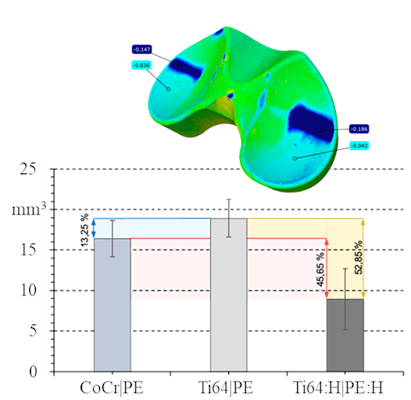
Results: Overall, uncoated implants showed higher total wear compared to coated systems. After 3.5 × 10⁶ cycles, Ti64|PE showed the highest wear (23.7 ± 2.0 mg), followed by CoCr|PE (20.9 ± 1.6 mg). The fully coated Ti64/a‑C:H|PE/a‑C:H configuration demonstrated the lowest wear (9.0 ± 2.2 mg). Wear rates were 7.0 ± 1.0 mg/10⁶ cycles (Ti64|PE), 6.0 ± 0.4 mg/10⁶ cycles (CoCr|PE), and 2.1 ± 0.7 mg/10⁶ cycles (Ti64/a-C:H|PE/a-C:H). These results indicate a wear reduction of ≈ 57% vs. CoCr|PE and ≈ 62% vs. Ti64|PE when using fully coated systems. Wear rates were lower than those typically reported in literature, partly due to modified kinematic boundary conditions allowing greater tibial rotation.
Discussion and conclusions: The experimental testing of TKRs demonstrated that a significant wear reduction was possible by DLC coatings. Due to the update of ISO14243, a quantitative comparison with previously published results regarding wear is, at present, not expedient. Also, the general limitations of a component tests under ideal conditions must be considered in order to derive well-founded, realistic wear predictions. Nevertheless, it can be stated that the service life of TKRs could be considerably increased by DLC coatings. However, detailed surface-analytical investigations of the coated components and generated wear particles are required to fully understand the underlying wear mechanisms.



