Deutscher Kongress für Orthopädie und Unfallchirurgie 2026 (DKOU 2026)
Gait analysis in knee osteoarthritis: Feasibility of generative foundation models for predicting center of pressure trajectory and load distribution
Text
Objectives and questions: Abnormal plantar pressure distribution, particularly a shift in the Center of Pressure (CoP), is a critical biomarker for knee osteoarthritis (OA) progression and joint loading. Conventionally, assessing these kinetic parameters requires instrumented gait laboratories or pressure-sensitive insoles, which limits accessibility for longitudinal monitoring. Recent developments in generative artificial intelligence have created a foundation model capable of inferring complex whole-body dynamics from sparse sensor inputs. This study investigates the feasibility of adapting this pre-trained generative foundation model (GaitDynamics) to estimate CoP trajectories and plantar pressure distribution using solely a single thigh-worn inertial measurement unit (IMU).
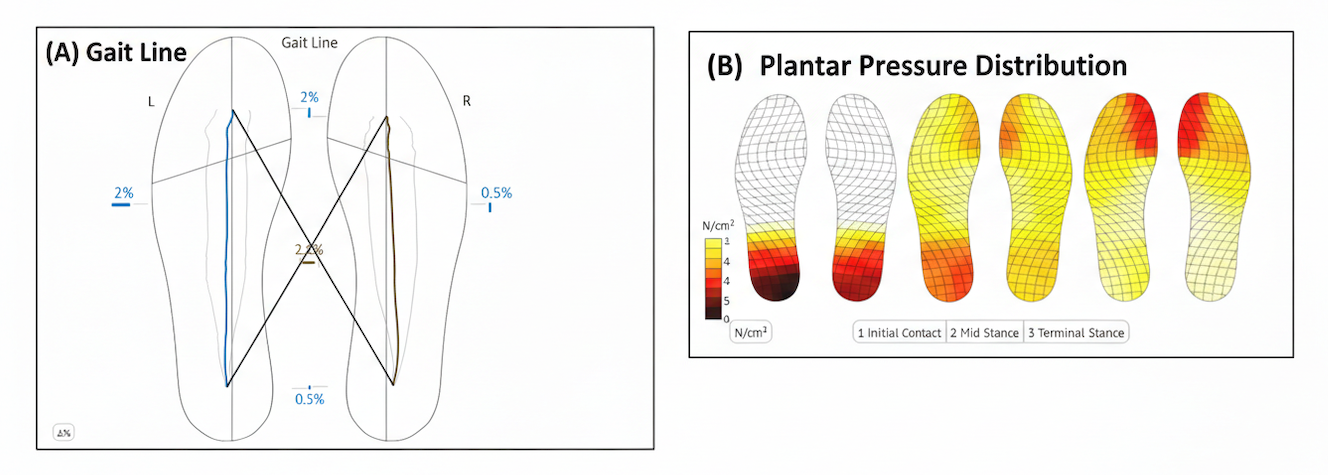
Material and methods: We utilized a dataset of 118 participants (87 with diagnosed knee OA and 31 healthy) performing two 1-minute walking trials. Participants wore an IMU on each thigh and pressure-sensitive smart insoles to capture ground truth CoP coordinates and vertical force distribution (Figure 1 [Fig. 1]). The GaitDynamics foundation model, trained on large-scale biomechanical datasets, served as the base architecture. We employed a transfer learning approach where the model’s diffusion-based core (representing physical constraints) was frozen, while the input and refinement layers were fine-tuned to map thigh orientation and acceleration directly to the insoles’ CoP coordinates. The model was tasked with predicting the missing kinetic data to reconstruct the gait line.
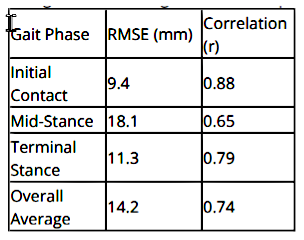
Results: Preliminary quantitative analysis demonstrates that the model successfully reconstructs the fundamental shape and temporal progression of the gait line from heel-strike to toe-off. Initial performance metrics indicate a Root Mean Square Error (RMSE) of approximately 14.2 mm for the CoP trajectory and a moderate correlation (Pearson’s r = 0.74) with the ground truth smart insole data. While the model accurately identifies the general medial-lateral loading trends, the predicted trajectories exhibit variance in peak excursion amplitudes compared to the ground truth, particularly during the mid-stance phase where load transfer occurs. The current prediction accuracy is promising for a single-sensor configuration but requires further optimization to reach clinical precision standards.
Discussion and conclusions: This study provides proof-of-concept evidence that generative foundation models can approximate plantar pressure dynamics from a single sensor. The results confirm that while the general gait line topology is recoverable, further hyperparameter tuning and extensive model training are necessary to minimize spatial errors. If refined, this approach could enable scalable, app-based monitoring of knee OA without the need for specialized or expensive devices.
Table 1 [Tab. 1]