
Deutscher Kongress für Orthopädie und Unfallchirurgie 2026 (DKOU 2026)
A bidirectionally coupled multiscale modeling framework for evaluating mechanobiological conditions in proximal femur fracture healing
Text
Objectives and questions: Fracture healing is governed by a complex interaction of biological processes and mechanical stimuli. Despite this, postoperative rehabilitation after osteosynthetic fracture fixation is still guided primarily by radiographic assessments and subjective clinical judgement. This study proposes a bidirectionally coupled multiscale modelling framework that integrates musculoskeletal loading and mechanoregulation finite element simulation to quantitatively predict the mechanobiological environment within the fracture gap under different rehabilitation loading conditions.
Material and methods: Musculoskeletal multibody simulations of bipedal stance and fully weight-bearing gait were conducted to determine hip joint reaction forces and muscle forces. These loads were transferred to FE models of a proximally nailed femur representing different stages of fracture healing. Local mechanical stimuli in the fracture gap were evaluated using two established mechanoregulation concepts, both of which predict tissue differentiation based on local stress and strain states (Figure 1 [Fig. 1]). By interpreting the calculated stimuli through both theoretical lenses, a consistent and robust picture of the mechanobiological environment under rehabilitation loading was obtained.
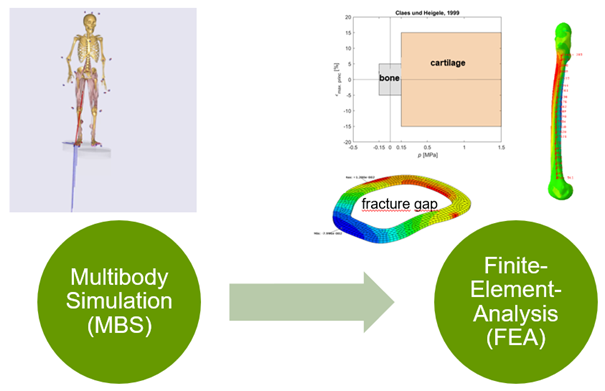
Results: Across both mechanoregulation approaches, dynamic gait loading consistently produced higher mechanical stimuli within the fracture gap than bipedal stance, shifting the predicted tissue differentiation away from bone and toward cartilage or fibrous tissue formation. In the initial healing stage, predicted cartilage differentiation increased substantially under gait loading (from 0% in stance to 32%), while bone-forming conditions declined from 100% to 68%. As healing progressed, this trend became even more pronounced: in the intermediate healing stage, cartilage-promoting conditions increased from 60.2% during stance to 91.7% during gait, while bone-promoting conditions decreased from 40% to 8%. Both theoretical models further indicated that gait loading led to a marked rise in fibrous-tissue-favouring conditions in the intermediate stage (e.g., 34.4% → 91.9%), again emphasizing a mechanical environment that is less supportive of intramembranous bone formation.
Discussion and conclusions: The multiscale modelling framework provides a detailed, quantitative assessment of the mechanobiological environment in osteosynthetically treated proximal femur fractures under realistic rehabilitation loading. The results demonstrate that full weight-bearing gait can generate mechanical stimuli that favour cartilage or fibrous tissue rather than bone formation, particularly in early and intermediate healing stages. This approach offers significant potential for informing individualized postoperative mobilization strategies that better support physiological bone healing.



