
Deutscher Kongress für Orthopädie und Unfallchirurgie 2026 (DKOU 2026)
Comparable meniscal repair survival after ACL primary repair and ACL reconstruction: A propensity score-matched cohort study
Text
Objectives and questions: Meniscal repairs performed concomitantly with anterior cruciate ligament (ACL) reconstruction (ACLR) have been reported to demonstrate higher healing rates and lower failure rates than isolated repairs, an effect often attributed to the biologically favorable environment created by tunnel drilling and intra-articular bone marrow release. With renewed interest in ACL primary repair (ACLPR) for selected tear patterns, it remains unclear whether this presumed biological advantage of ACLR persists. This study compared meniscal repair survival and clinical outcomes between ACLPR and ACLR using a propensity score-matched cohort.
Material and methods: Patients undergoing ACLPR or ACLR with concomitant meniscal pathology between 2012 and 2023 at a single institution were retrospectively identified. Treatment groups were balanced using propensity score matching based on age, body mass index (BMI), preinjury Tegner activity level, and type of meniscal intervention. Inclusion required minimum 2-year follow-up. Meniscal failure was defined as any reoperation involving the index meniscus. Failure and survival rates were assessed including Kaplan-Meier analysis. Patient-reported outcomes, including the International Knee Documentation Committee (IKDC) subjective score, Forgotten Joint Score (FJS), and ACL Return to Sport after Injury (ACL-RSI) scale, were compared using independent-samples t-tests.
Results: After matching, 142 knees were analyzed, including 71 ACLPR and 71 ACLR procedures (female, 42.2%; age, 27.9±9.9 years; BMI, 25.4±4.7 kg/m2) with a mean follow-up of 3.6±2.0 years. ACLPR patients were older (31.5±8.9 vs. 24.2±9.5 years; p<0.001) and had lower preoperative Tegner scores (7±2 vs 8±2; p=0.03), while sex, BMI, and distribution of medial and lateral meniscal treatment, did not differ between groups (all p>0.05). Medial meniscal repair was performed in 41 ACLPR and 46 ACLR knees, and lateral meniscal repair in 38 and 46 knees, respectively. Meniscal failure occurred in 7/71 patients (9.9%) after ACLPR and 14/71 patients (19.7%) after ACLR (p=0.098). Kaplan-Meier analysis demonstrated no statistically significant difference in meniscal survival, with mean survival times of 9.9 years after ACLPR and 9.4 years after ACLR (log-rank, p=0.083); (Figure 1 [Fig. 1]). At final follow-up, available patient-reported outcomes were comparable between groups: IKDC subjective score 85.8±11.4 after ACLPR versus 84.2±10.9 after ACLR (p=0.418), FJS 85.9±15.6 versus 87.2±16.9 (p=0.655), and ACL-RSI 69.6±24.2 versus 67.6±25.9 (p=0.648).
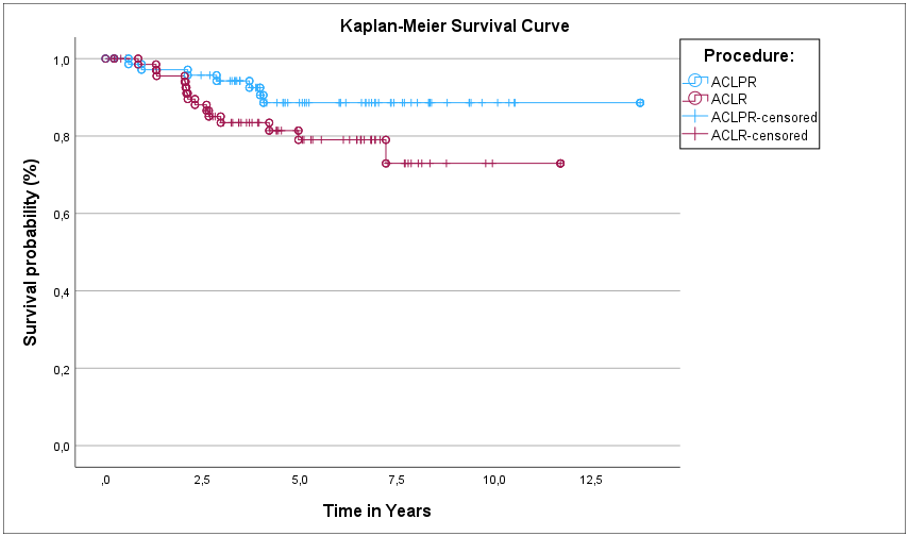
Discussion and conclusions: After controlling for baseline and demographic differences, meniscal repairs performed with ACLPR demonstrated comparable failure rates, meniscal survival, and patient-reported outcomes compared with meniscus repairs performed with ACLR. These findings challenge the assumption that tunnel drilling during ACLR inherently promotes superior meniscal healing and suggest that previously reported advantages may partly reflect differences in patient and injury characteristics.



