
Deutscher Kongress für Orthopädie und Unfallchirurgie 2026 (DKOU 2026)
Recombinant Plat alleviates bone loss in ovariectomized mice
Text
Objectives and questions: More than 200 million women worldwide suffer from postmenopausal osteoporosis, a condition primarily driven by estrogen deficiency during menopause, leading to reduced bone mass and increased fracture risk. Despite significant advances in the understanding of bone biology, there remains a critical need for effective osteoanabolic strategies that restore bone formation and improve bone quality in postmenopausal osteoporosis. Plasminogen activator tissue type (Plat) has previously been identified as a mechanoresponsive factor that positively regulates osteoblast differentiation (Ahmad et al., 2024). In addition, Plat expression was shown to be significantly reduced in postmenopausal and aged mice. Thus, we hypothesized that treatment with recombinant Plat (rPlat) may prevent the development of postmenopausal osteoporosis and improve bone quality.
Material and methods: All animal experiments were approved by the local ethical committee (license no. 1626). Eight-week-old female C57BL/6J mice underwent ovariectomy (OVX) or sham surgery to induce an osteoporotic phenotype. One week after surgery, mice received either saline (Vehicle) or rPlat (3 mg/kg/day) intravenous injections twice per week. After 3.5 weeks of treatment, animals were sacrificed via isoflurane overdose. Bone parameters were assessed by biomechanical testing and micro-computed tomography (µCT). RNA was isolated from tibiae devoid of bone marrow, followed by gene expression analysis (qPCR). Statistical evaluation was performed using one- and two-way ANOVA with uncorrected Fisher’s LSD post hoc test. Statistical significance was defined as p<0.05.
Results: Under physiological conditions, rPlat treatment did not affect bone mechanical properties or microarchitecture. Three-point bending test revealed no differences in femoral stiffness (N*mm2) (2,296 ± 508 vs 2,079 ± 506), and µCT analysis showed comparable bone volume fraction (BV/TV) between vehicle- and rPlat-treated sham mice (7.3% ± 0.6 vs 7.4% ± 1.2). Successful OVX was confirmed by significant reduction in uterine weight in both OVX groups compared to sham controls (Figure 1A [Fig. 1]). OVX resulted in a pronounced deterioration of trabecular and cortical parameters, including reduced BV/TV, trabecular thickness (Tb.Th), trabecular number (Tb.N), and cortical thickness (Ct.Th). Notably, rPlat treatment effectively prevented OVX-induced bone loss and restored these parameters to levels comparable to sham controls (Figure 1B [Fig. 1]). qPCR revealed that OVX significantly reduced osteoblast-related marker gene expression (Sp7, Alpl, and Bglap), which was ameliorated by rPlat treatment (Figure 1C [Fig. 1]). In contrast, no differences were observed in osteoclast marker expression between groups, suggesting that rPlat primarily targets osteoblastogenesis.
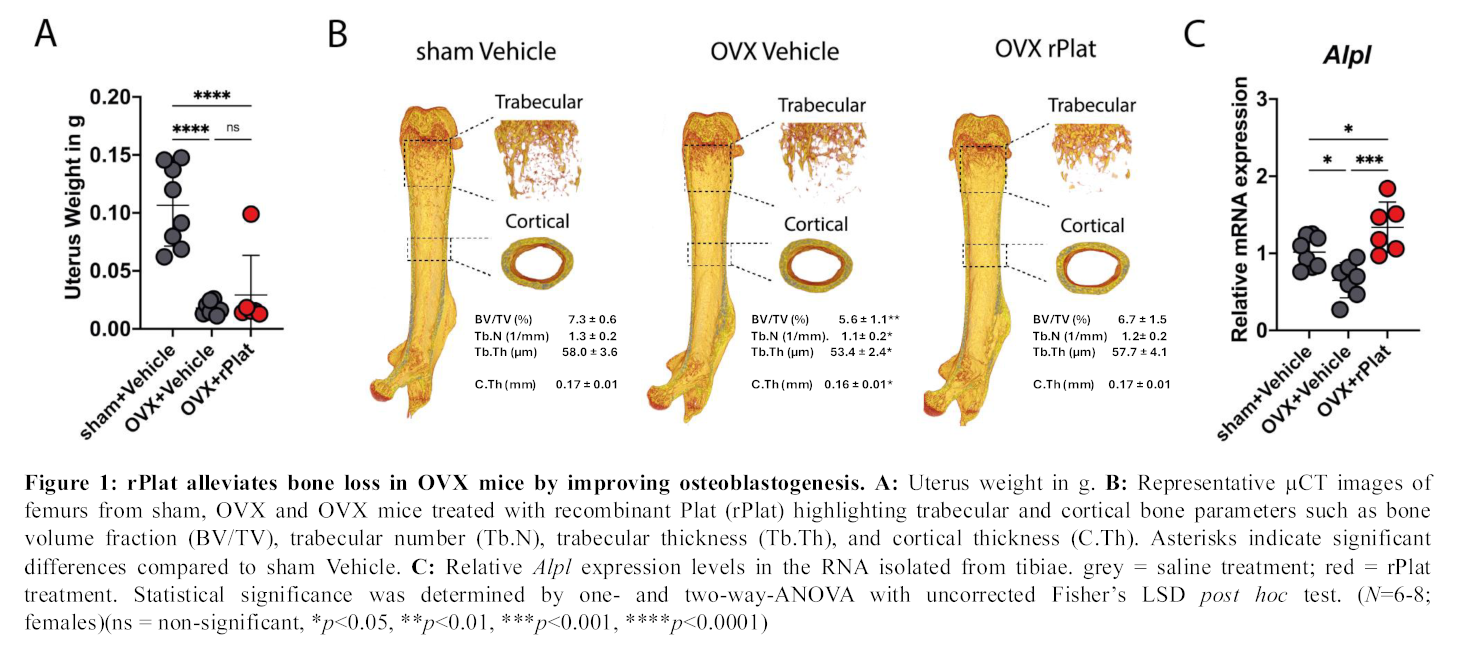
Discussion and conclusions: Recombinant Plat treatment does not affect bone microarchitecture under physiological conditions but effectively protects against OVX-induced bone loss, highlighting its potential as a novel therapeutic strategy for postmenopausal osteoporosis.



