
Deutscher Rheumatologiekongress 2026
Dysregulated granzyme K induction and accelerated cytotoxic maturation of CD4 T cells in rheumatoid arthritis
Text
Introduction: CD4 cytotoxic T lymphocytes (CTLs) constitute a chronically stimulated T helper cell population involved in autoimmunity and chronic infection [1]. In rheumatoid arthritis (RA), CD4 CTLs expand in blood and synovial tissue, sustaining systemic and local inflammation [2]. However, the mechanisms by which they contribute to autoimmune pathology remain incompletely understood. Interrogating CD4 CTL differentiation states and induction dynamics in RA may therefore reveal disease-specific features that shape autoimmunity.
Methods: CD4 CTLs were characterized by scRNA-seq of peripheral T cells from RA patients (n=3) and healthy donors (HD, n=2), then validated by flow cytometry in an independent cohort (RA n=15, HD n=16). Differentiation dynamics were probed by assessing CTL subset markers following stimulation (anti-CD3/CD28) at 48 h and 72 h (RA n=5, HD n=4).
Results: ScRNA-seq identified two CTL clusters distinguished by granzyme K (GZMK) or granzyme B (GZMB) expression, both upregulating canonical cytotoxic markers (PRF1, GZMA). The GZMK+ cluster retained markers of less differentiated cells (CCR7, CD27) with intermediate cytotoxicity scores, suggesting a precursor state to terminally differentiated GZMB+ CTLs (Figure 1A,B [Fig. 1]). Flow cytometry confirmed this hierarchy and showed that in RA, GZMK+ CTLs were numerically reduced yet expressed significantly higher cytotoxic markers than HD, indicating accelerated cytotoxic maturation (Figure 1C, D [Fig. 1]).
Figure 1: A) Differentially expressed genes of non-cytotoxic, GZMK+ CD4 CTL and GZMB+ CD4 CTL subset as indicated. The size of the dots are the percentage of cells expressing a gene, the color reflects the scaled average expression for each gene. B) Median cytotoxicity module scores. Each point represents one sample, boxplot show median (center line), interquartile range (box) and whiskers extending to 1.5x the interquartile range. C) Expression of canonical cytotoxicity-associated markers in non-cytotoxic, GZMK+ CD4 CTLs and GZMB+ CD4 CTLs in HD and RA. D) Percentage of peripheral CD4 T cells expressing GZMK in HD and RA. For C and D: height of bars indicate median, whiskers indicate interquartile range. Mann-Whitney-U test, *p<0.5, **p<0.01, ****p<0.001.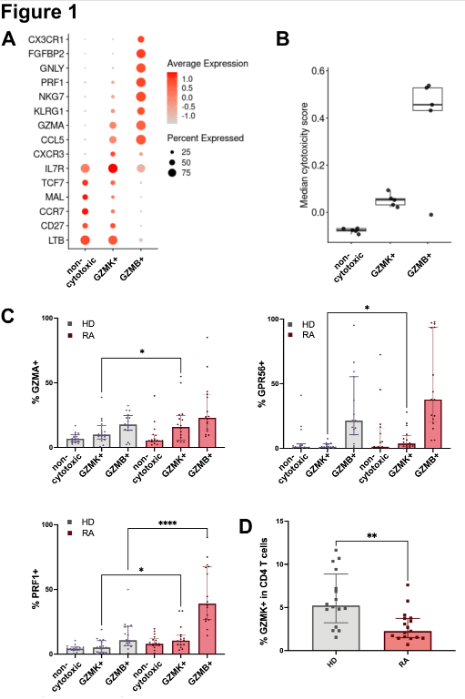
Strikingly, TCR stimulation revealed altered differentiation dynamics in RA. In HD, GZMK expression peaked at 48 h before falling below baseline by 72 h, consistent with a transient intermediate state (Figure 2A [Fig. 2]). In RA, GZMK expression continued rising through 72 h, remaining at lower absolute levels than in HD. Simultaneously, GZMB induction was amplified at both time points in RA, indicating that terminal CTL differentiation is elevated and accelerated in disease (Figure 2B [Fig. 2]).
Figure 2: (A) Granzyme K and (B) granzyme B expression were measured in CD4 T cells at baseline and following T cell receptor stimulation (anti-CD3/CD28) for 48h and 72h. Dots represent median; whiskers indicate standard error mean. 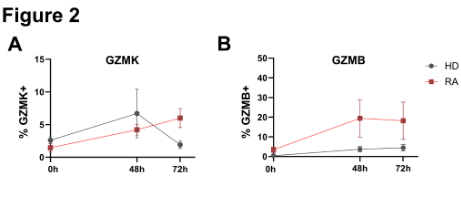
Conclusion: CD4 CTLs comprise a GZMK+ intermediate and a GZMB+ terminally differentiated subset, likely representing sequential differentiation states. In RA, the GZMK+ state is numerically reduced and prematurely driven toward the terminal GZMB+ state. These findings carry two implications: first, the homeostatic function of GZMK+ CTLs appears impaired in RA through accelerated maturation; second, this accelerated cytotoxic maturation represents a disease-associated feature of RA, warranting further investigation into its contribution to disease pathogenesis.
Disclosures: The authors have nothing to disclose.