
Deutscher Kongress für Orthopädie und Unfallchirurgie 2026 (DKOU 2026)
Obesity reprograms the endothelial inflammatory response toward sterol pathway suppression during acute post-traumatic stress
Text
Objectives and questions: Early post-traumatic inflammation requires rapid endothelial activation to coordinate leukocyte recruitment, vascular remodeling, and subsequent tissue regeneration. Obesity is associated with increased complications after trauma, yet it remains unclear whether the obese adipokine milieu amplifies inflammatory signaling or fundamentally alters the endothelial response during acute inflammatory stress. We hypothesized that obesity induces qualitative metabolic reprogramming of inflamed endothelium, thereby compromising regenerative vascular competence.
Material and methods: Primary human endothelial cells were exposed for 6 hours to TNFα and IL-1β, either alone or combined with lean or obese adipokine cocktails reflecting clinically relevant differences in leptin, adiponectin, resistin, and visfatin. To identify coordinated transcriptional shifts, genome-wide expression profiling was performed using whole-genome microarrays with robust multi-array average normalization and log2 transformation. Differential expression was assessed using Welch’s t-test with Benjamini–Hochberg correction (FDR < 0.05; |log2FC| ≥ 0.5). Integrated contrast analysis focused on pathway-level reprogramming.
Results: Inflammatory stimulation induced a robust endothelial activation signature, including ICAM1, VCAM1, and SELE. Lean adipokine conditioning significantly reshaped the inflammatory transcriptome (24 genes vs inflammation alone), prominently engaging sterol and lipid regulatory programs, including INSIG1, HMGCS1, MVD, and SREBF2 (log2FC ~0.8–1.9), consistent with coordinated metabolic adaptation during inflammatory stress (Figure 1 [Fig. 1]). In contrast, obese adipokines did not further enhance canonical adhesion signaling (0 genes significant vs inflammation alone). However, direct comparison of obese versus lean conditioning revealed coherent suppression of sterol and lipid biosynthesis networks, including INSIG1 (−1.44), HMGCS1 (−1.28), DHCR24 (−0.89), FASN (−1.18), and PLA2G4C (−1.09). Pathway-level analysis demonstrated systematic downregulation of metabolic programs essential for membrane remodeling and endothelial plasticity (Figure 1 [Fig. 1]).
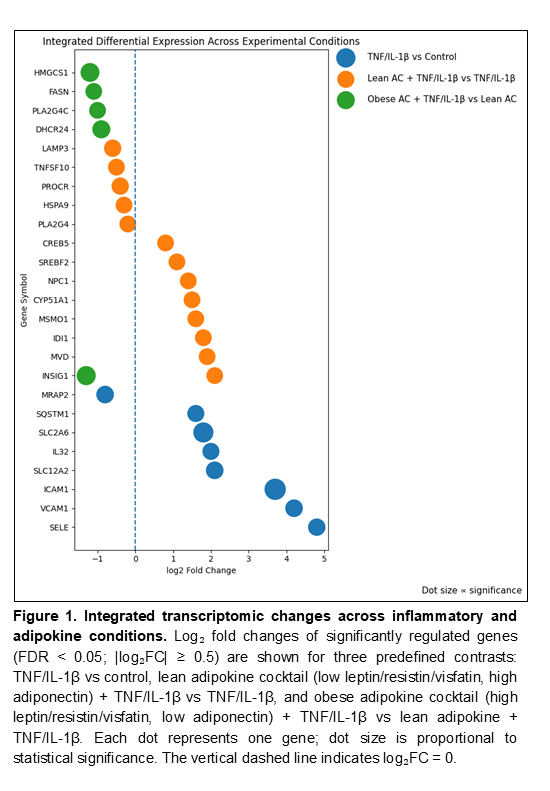
Discussion and conclusions: These data identify adipokine-dependent metabolic reprogramming as a previously underappreciated axis of endothelial regulation during acute inflammatory stress. Rather than amplifying classical inflammatory activation, obese adipokines selectively suppress sterol and lipid biosynthetic pathways that are critical for adaptive vascular remodeling. This transcriptomic screening defines a mechanistic framework that is currently being extended through functional metabolic assays and translational trauma models to determine whether sterol pathway suppression directly limits endothelial regenerative competence. Together, these findings position endothelial metabolic adaptation as a potential therapeutic target in obese trauma patients.



