
Deutscher Kongress für Orthopädie und Unfallchirurgie 2026 (DKOU 2026)
Regulatory-level simulation validation for orthopedic bone-plate design optimization
Text
Objectives and questions: Computational modeling and simulation can accelerate orthopedic implant innovation, but regulatory use requires demonstrated model credibility. The primary objective of this work was to establish regulatory-level verification and validation (V&V) of a finite element analysis model for biomechanical fatigue testing of orthopedic bone-plate constructs under the ASME V&V40 risk-informed framework. A secondary objective was to demonstrate retrospective use of a validated simulation model for comparative performance assessment and design optimization.
Material and methods: A finite element model was developed to replicate a distal femur comminuted-fracture fatigue test using a Stryker Pangea distal medial femur plate (Ti6Al4V) fixed with seven Pangea locking screws (Co28Cr6Mo) under combined axial and torsional loading. Stryker Orthopaedic Modeling and Analytics (SOMA) was used to define a representative bone model and ensure plate fit. Model credibility was enhanced by incorporating experimentally derived stiffness parameters for the screw–plate interface from calibrated bench testing. Verification and validation activities followed ASME V&V40 and FDA guidance for computational modeling, including software quality assurance, numerical code verification, discretization error quantification, and use-error assessment. Validation was performed retrospectively using biomechanical fatigue testing to assess failure mode and complemented by Zeiss ARAMIS 3D digital image correlation to compare six-degree-of-freedom construct kinematics (Figure 1 [Fig. 1]). Agreement between experimental and simulation results was quantified using root mean square error (RMSE) and linear regression (R²). Following validation, the model was applied retrospectively to compare the Pangea construct against defined reference constructs for deformation and stress-based performance metrics.
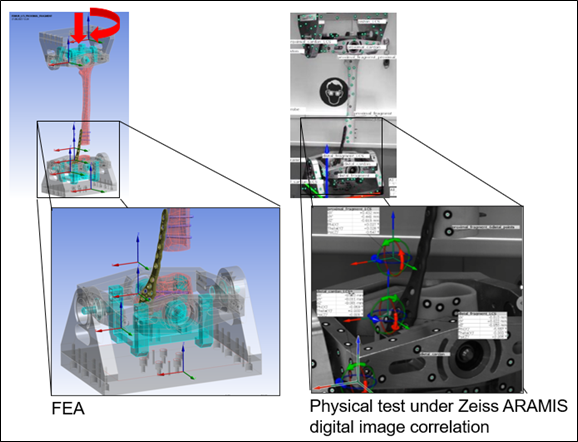
Results: Verification demonstrated numerical convergence and agreement with analytical benchmarks. In ARAMIS compression validation, displacement RMSE was 0.078 mm and rotational RMSE was 0.064°, both below the acceptance threshold of 0.1, with strong correlation between experimental and simulated results (R² = 0.951). Fatigue validation correctly predicted plate breakage failure site compared to physical test data. Based on the accumulated evidence, the computational model achieved the required credibility level for its defined context of use. In the retrospective comparative analysis, the Pangea construct exhibited reduced deformation and lower maximum principal stresses in the plate and screws relative to reference constructs.
Discussion and conclusions: This study demonstrates that regulatory-level, statistics-driven V&V enables credible in silico comparative assessment and design optimization of orthopedic bone-plate constructs. Once validated, such simulation models can support design decision-making and accelerate design freeze in orthopedic implant development and regulatory submissions.



