
Deutscher Kongress für Orthopädie und Unfallchirurgie 2026 (DKOU 2026)
Real-world gait analytics and patient-reported outcomes in knee osteoarthritis and total knee arthroplasty: App-based correlations between gait tests and PROMs
Text
Objectives and questions: Patient-reported outcome measures (PROMs) such as the Knee injury and Osteoarthritis Outcome Score (KOOS) and global knee satisfaction (GKS) are central to the evaluation of knee osteoarthritis (KOA) and outcomes after knee arthroplasty (KA). However, these subjective measures are only intermittently assessed and may not fully capture functional performance in daily life. Advances in mobile health technologies enable continuous, real-world acquisition of objective gait data using smartphones and wearables. An app developed for the study was used to regularly measure gait parameters and PROMS independently by the patients themselves. The aim of the study was to investigate the correlation between app-derived real-world gait parameters and PROMs in patients with KOA and/or KA.
Material and methods: In this prospective pilot study, 120 adults with KOA and/or status post-KA were enrolled to use a purpose-built mobile application (NewKnee App) for continuous gait data collection during daily activities. Of the total cohort, 51 participants provided complete longitudinal datasets for final analysis. Gait and activity features were derived from the iPhone’s embedded inertial measurement units (IMUs) and extracted via Apple Health (HealthKit), including e.g. step count, step length, walking speed. PROMs were captured using KOOS item-level questionnaires administered every 3 weeks from app installation. Associations between KOOS items and digital mobility features were explored using pairwise Spearman rank correlations (ρ). Correlation patterns were visualized using a lower-triangular correlation heatmap to identify clusters of related variables.
Results: The Spearman correlation matrix identified distinct clustering within PROMs, reflecting high internal consistency among KOOS pain and symptom features (see Figure 1 [Fig. 1]). Objective gait metrics formed a coherent biomechanical cluster, where walking speed demonstrated a robust positive correlation with step length and an inverse relationship with double-support time, confirming physiological validity. Notably, subjective and objective domains converged: higher symptom burden (worse KOOS scores) was significantly associated with a ‘protective’ gait signature characterized by reduced speed, shorter step length, and increased asymmetry.
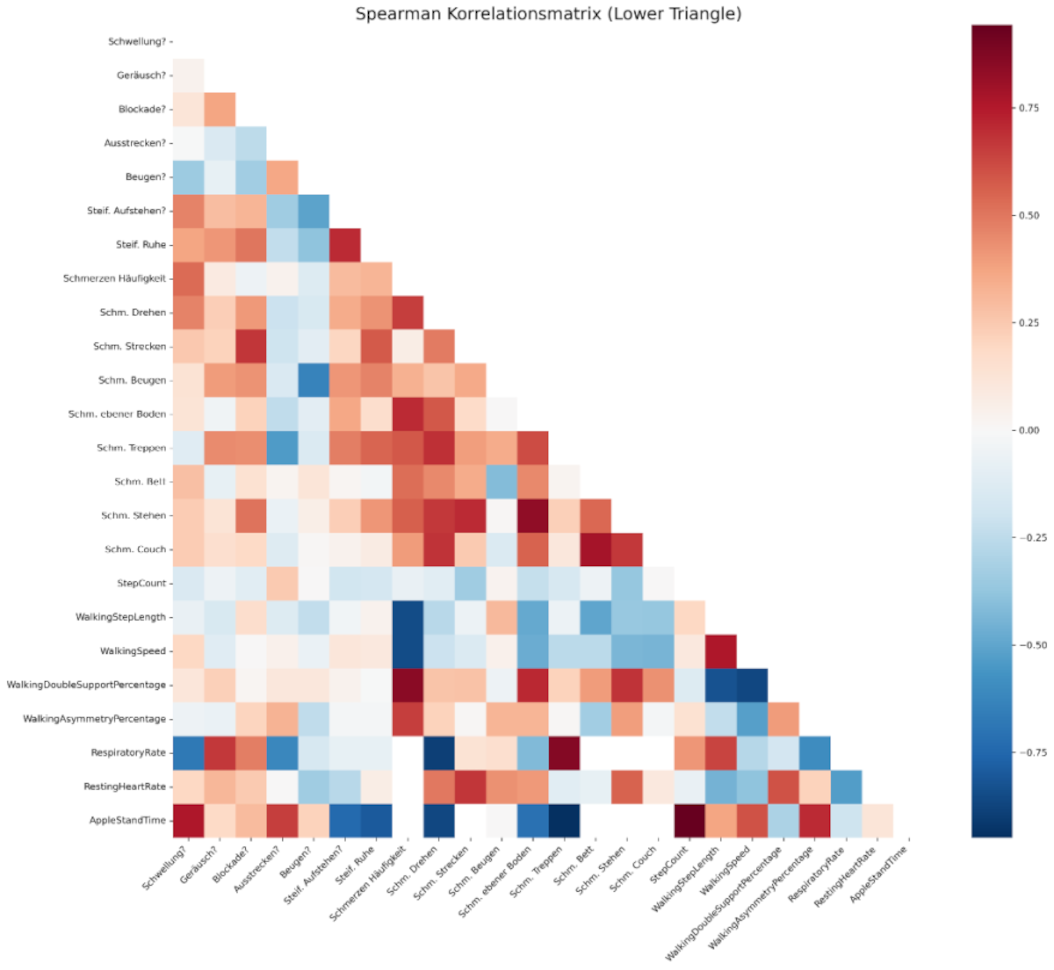
Discussion and conclusions: App-based real-world gait analytics meaningfully correlate with established PROMs in patients with KOA and after KA. The strong alignment between high symptom burden and an objective ‘protective’ gait signature validates digital mobility analysis as a reflection of daily functional status. These findings demonstrate that continuous mobile monitoring can effectively complement intermittent questionnaires, enabling granular assessment of disease burden and treatment response in routine clinical care.



