
Deutscher Kongress für Orthopädie und Unfallchirurgie 2026 (DKOU 2026)
Assessment of immunological competence as a risk factor for implant-associated infections in hip arthroplasty
Text
Objectives and questions: Implant-associated infections are more frequent after fracture-related hip arthroplasty than elective osteoarthritis (OA). This study examined differences in immune cell distribution, phenotypic profiles, and circulating cytokines between fracture and osteoarthritis patients to investigate whether altered immunological competence contributes to increased infection risk.
Material and methods: In this prospective study, 50 patients undergoing total hip arthroplasty were enrolled (OA 25, F 25). Peripheral blood was collected preoperatively and on postoperative days 1, 3, and 7. Immune cell phenotypes were analyzed by flow cytometry, and cytokine responses were assessed using cell stimulation assays and plasma multiplex analysis. Group differences over time were evaluated using paired and between-group statistical comparisons, with significance set at p < 0.05.
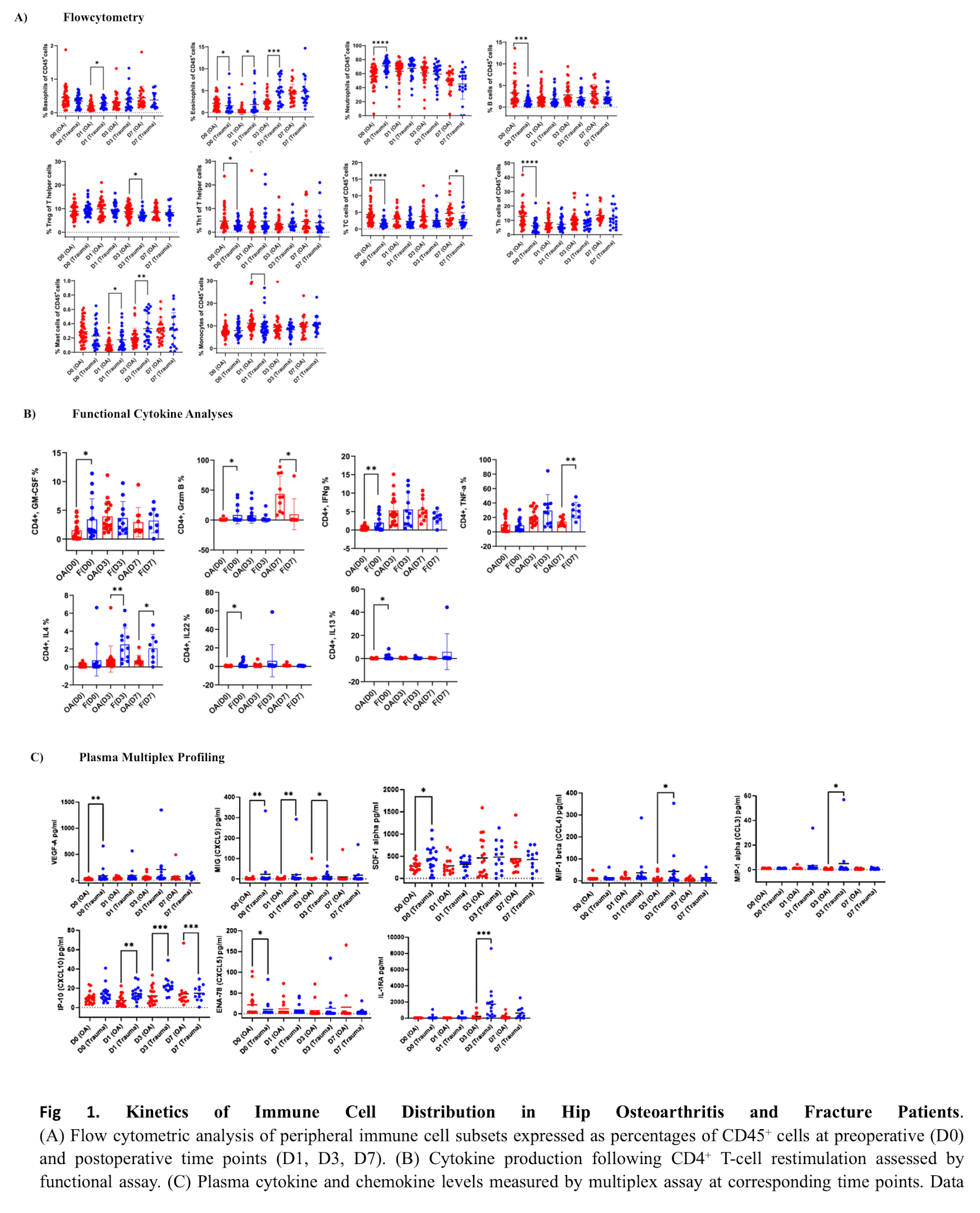
Results: Flowcytometry revealed that at baseline (D0), fracture patients exhibited higher neutrophil and eosinophil counts, together with reduced B cells, cytotoxic T cells, T-helper cells, and Th1 subsets compared with OA patients. At postoperative day 3, fracture patients showed increased eosinophils and mast cells, while monocytes, regulatory T cells, and cytotoxic T cells were significantly reduced (Figure 1 A [Fig. 1]). Functional cytokine analyses following CD4⁺ T-cell restimulation revealed increased production of GM-CSF, granzyme B, IFN-γ, IL-13, and IL-22 in fracture patients at D0. Postoperatively, IL-4 and TNF-α production increased in fracture patients, whereas granzyme B production and central memory T-cell frequencies were reduced compared with OA patients (Figure 1 B [Fig. 1]). Plasma multiplex profiling showed higher VEGF-A, SDF-1, MIG, and ENA at D0 in fracture patients, except for ENA, which was higher in OA patients. Postoperatively, fracture patients exhibited elevated MIP-1α, MIP-1β, MIG, IP-10, and IL-1RA at specific time points (Figure 1 C [Fig. 1]).
Discussion and conclusions: This study provides the first evidence that altered immunological competence in fracture patients, particularly affecting granulocyte and T-cell subsets, could represent an important intrinsic risk factor contributing to increased susceptibility to implant-associated infections following hip arthroplasty. These findings underscore the potential value of perioperative immune profiling for improved risk stratification in trauma surgery.



