
Deutscher Kongress für Orthopädie und Unfallchirurgie 2026 (DKOU 2026)
Tibiotalar arthrodesis: A biomechanical comparison of anterior and posterior plate fixation
Text
Objectives and questions: Plate fixation techniques for tibiotalar (TT) arthrodesis have demonstrated to be biomechanically superior compared with screw-only constructs and have historically shown promising clinical outcomes. However, direct comparative studies between different plate fixation techniques are limited. Therefore, this study aimed to investigate the biomechanical differences between the anterior and posterior TT arthrodesis locking plates.
Material and methods: This experimental biomechanical in vitro study included six pairs of fresh-frozen human lower leg specimens (n = 12), which were randomized using a paired design for either anterior or posterior fixation. Initial ankle flexibility tests with bending moments of 2.5 Nm in plantar flexion/dorsiflexion (PF/DF); eversion/inversion (Ev/Inv) and internal/external rotation (IR/ER) were conducted, and the range of motion (ROM) was measured at the TT and the talocalcaneal (TC) joints. Subsequently, cyclic loading in PF/DF was applied to simulate partial weight-bearing in five intervals with increasing load magnitude (starting with 10 Nm and increasing by 7.5 Nm every 200 load cycles). Flexibility tests were repeated after each loading interval. Construct failure was defined as either excessive displacement at the fusion site (>10°), implant failure, or bone failure. Statistical analysis was performed using paired Wilcoxon signed-rank tests. A two-sided p-value < 0.05 was considered statistically significant.
Results: No construct failures were observed. In the TT joint, during initial flexibility testing, the anterior plate (AP) group showed significantly lower ROM (PF/DF: 0.110° [IQR 0.083–0.148]) compared with the posterior plate (PP) group (PF/DF: 0.405° [IQR 0.320–0.468]) across all motion planes (p = 0.027–0.028) (Figure 1 [Fig. 1]). In the course of cyclic loading, the TT joint ROM increased progressively for both plate fixation techniques. However, for the AP group the TT joint ROM remained significantly lower compared to the PP group at all loading stages and in all motion planes (p = 0.027–0.043). In the TC joint, no significant differences were observed between the AP and PP group in initial flexibility tests and after cyclic loading, with both groups showing a gradual increase in motion in the course of cyclic loading.
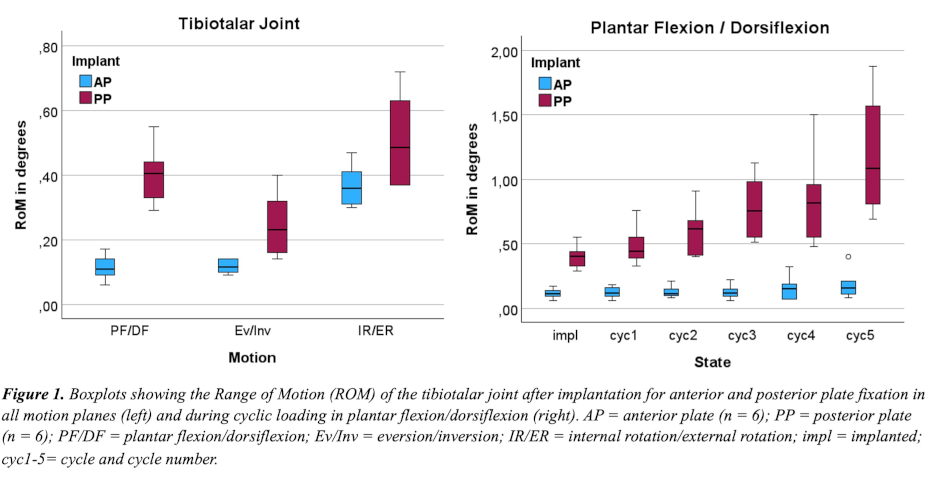
Discussion and conclusions: AP fixation resulted in lower ROM, providing greater stability of the tibiotalar joint than PP fixation. This suggests that the anterior plate fixation may offer biomechanical advantages for the tibiotalar arthrodesis. However, clinical studies are required to further investigate whether these biomechanical differences also have an effect on clinical outcomes.



