
42. Wissenschaftliche Jahrestagung der Deutschen Gesellschaft für Phoniatrie und Pädaudiologie (DGPP)
Computational analysis of aerodynamic characteristic of unilateral vocal fold paralysis
Zusammenfassung
Background: Unilateral vocal fold paralysis (UVFP) is a frequent organic voice disorder characterized by a complete immobility of one vocal fold (VF). It is mostly caused by a damage of the recurrent laryngeal nerve due to thyroid surgery, surgery at the anterior cervical spine or thoracic surgery. UVFP does not only impair the sound generation during phonation characterized by a breathy voice. Affected patients often suffer from reduced phonation time indicating a disturbed aerodynamic energy transfer during phonation. Thus, this study aims to analyze the laryngeal flow field to identify underlying aerodynamic effects of UVFP.
Materials and methods: The study was performed within our CFD larynx model. To model UVFP, the right VF represented the paralyzed fold and was fixed at four lateral positions (median, paramedian, intermedian, lateral) with the left VF starting from normal or hypercompensated position. The VFs’ oscillations were prescribed based on experimental data. Parameters as flow-rate, glottal resistance, energy transfer between airflow and tissue, and flow velocity were analyzed.
Results: With increasing abducted position of the paralyzed VF, UVFP produces an increased flow-rate and decreasing glottal resistance, resulting in a drop in aerodynamic energy transfer rate into the VF tissue. These effects were slightly compensated or reduced when the initial position of the left, oscillating VF was hyper-compensated. In this case, its medial surface was closer to the paralyzed right VF reducing the minimal glottal gap during oscillation. The glottal jet was skewed for UVFP in the coronal and sagittal planes producing a turbulent 3D supraglottal flow field.
Conclusion: The main impairment of UVFP is the reduction of the aerodynamic energy transfer into the VFs. This corresponds to patients’ reports about air loss during phonation, especially for highly abducted paralyzed VF. Furthermore, the increase of turbulent structures in the supraglottal flow field potentially reduces the periodic nature of the glottal jet, likely reducing the tonal sound generation. Although a previous study did not find a systematic influence on the symptoms of UVFP in patients, the hypercompensation of the non-paralyzed VF showed a slight compensation of UVFP effects in this computational model.
Text
Introduction
Unilateral vocal fold paralysis (UVFP) is a frequent organic voice disorder characterized by a complete immobility of one vocal fold (VF). It is mostly caused by a damage of the recurrent laryngeal nerve due to thyroid surgery, surgery at the anterior cervical spine or thoracic surgery [1]. UVFP does not only impair the sound generation during phonation characterized by a breathy voice. Affected patients often suffer from reduced phonation time indicating a disturbed aerodynamic energy transfer during phonation. Thus, this study aims to analyze the laryngeal flow field to identify underlying aerodynamic effects of UVFP.
Methods
The study was performed within our CFD larynx model shown in Figure 1 [Fig. 1] [2]. To model UVFP, the right VF represented the paralyzed fold and was fixed at four lateral positions (median, paramedian, intermedian, lateral) with the left VF starting from normal or hypercompensated position. The VFs’ oscillations were prescribed based on experimental data. Parameters as flow-rate, glottal resistance, energy transfer between airflow and tissue, and flow velocity were analyzed.
Figure 1: Life-size CFD model including the vocal folds, the ventricular folds and the vocal tract [2]. The vocal folds motion is prescribed based on a corresponding experimental model. The vocal tract represents the simplified geometry of a tract for vowel /a/ phonation.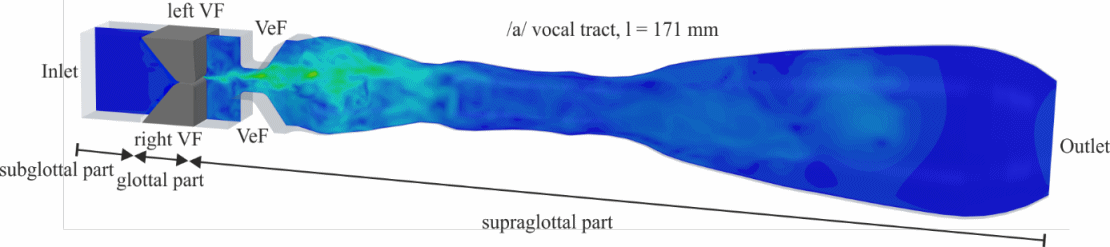
Results
With increasing abducted position of the paralyzed VF, UVFP produces an increased flow-rate and decreasing glottal resistance, resulting in a drop in aerodynamic energy transfer rate into the VF tissue. These effects were slightly compensated or reduced when the initial position of the left, oscillating VF was hypercompensated. In this case, its medial surface was closer to the paralyzed right VF reducing the minimal glottal gap during oscillation. The glottal jet was skewed for UVFP in the coronal and sagittal planes producing a turbulent 3D supraglottal flow field.
Conclusion
The main impairment of UVFP is the reduction of the aerodynamic energy transfer into the VFs. This corresponds to patients’ reports about air loss during phonation, especially for highly abducted paralyzed VF. Furthermore, the increase of turbulent structures in the supraglottal flow field potentially reduces the periodic nature of the glottal jet, likely reducing the tonal sound generation. Although a previous study did not find a systematic influence on the symptoms of UVFP in patients [3], the hypercompensation of the non-paralyzed VF showed a slight compensation of UVFP effects in this computational model.
Literatur
[1] Rubin AD, Sataloff RT. Vocal fold paresis and paralysis. Otolaryngol Clin North Am. 2007 Oct;40(5):1109-31, viii-ix. DOI: 10.1016/j.otc.2007.05.012[2] Falk S, Kniesburges S, Schoder S, Jakubaß B, Maurerlehner P, Echternach M, Kaltenbacher M, Döllinger M. 3D-FV-FE Aeroacoustic Larynx Model for Investigation of Functional Based Voice Disorders. Front Physiol. 2021 Mar 8;12:616985. DOI: 10.3389/fphys.2021.616985
[3] Yumoto E, Sanuki T, Minoda R, Kumai Y, Nishimoto K, Kodama N. Over-adduction of the unaffected vocal fold during phonation in the unilaterally paralyzed larynx. Acta Otolaryngol. 2014 Jul;134(7):744-52. DOI: 10.3109/00016489.2014.886020