
28. Jahrestagung der Deutschen Gesellschaft für Audiologie e. V.
When the input is not degraded: deficits in written language processing in age-related hearing loss
Text
Research question: Research on age-related hearing loss (HL) has mainly focused on auditory input processing. However, recent findings indicate that HL can also impair non-auditory modalities such as written language processing and reading ability [1], [2]. This raises questions for theories of language and cognition in HL, including the Information Degradation Hypothesis (IDH) [3] which postulates that degraded auditory input strains cognitive resources. If HL also affects reading, this suggests broader impact on the language system beyond temporary cognitive strain. We therefore ask: To what extent does HL affect higher-level written language processing (word and sentence processing) in older adults, and how does cognitive capacity, particularly working memory, modulate these effects?
Methods: Participants were older German-speaking adults: 39 with normal hearing (NH; mean age 61.2) and 48 with HL, namely 34 using hearing aids (HA; 69.7), and 14 without hearing aids (no-HA; 68.9). They were tested on two reading tasks: (1) word processing via a lexical decision task with 40 high/low frequency words and 40 pseudowords, (2) sentence processing via a word-for-word reading task involving more and less complex sentences combined with picture selection to test reading comprehension. Additional measures include: a verbal and numerical working memory task, pure tone averages (PTA), and duration of hearing aid use in HA.
Results: (see Figures 1 [Fig. 1] & 2 [Fig. 2]): Word processing: All participants showed typical word frequency effects: higher accuracy and faster response times for high frequency words. HA users were slower than NH. For HA, higher working memory supported accuracy, especially for low-frequency words. Sentence processing: More complex sentences were more difficult, with lower accuracy and longer response times. HA users performed more slowly and less accurately than NH, and in some cases worse than no-HA too. For HA, working memory again supported performance, especially under high load. Performance was negatively correlated with age in HA and no-HA groups and, in some cases, with PTA. No positive effects of hearing aid use duration were observed.
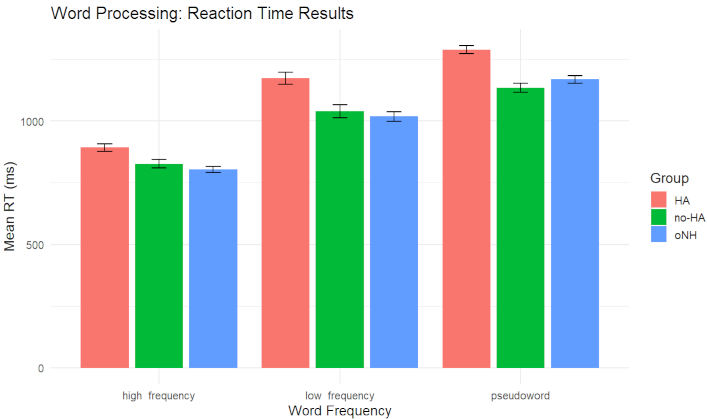
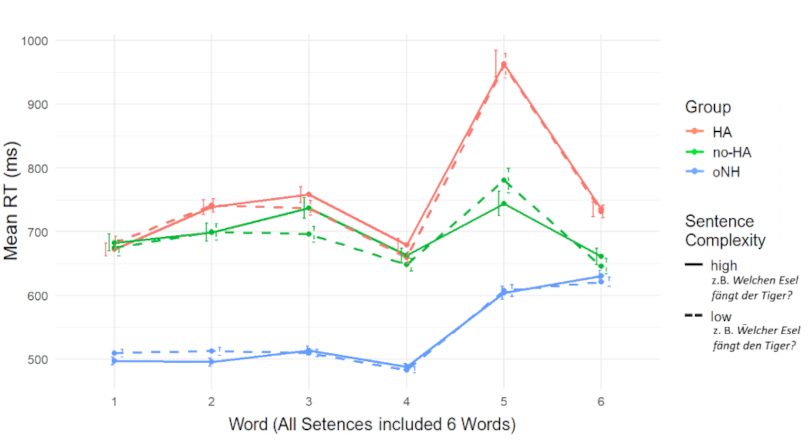
Conclusions: Results indicate that HL impairs not only auditory but also written language processing. HA users were most affected, potentially to due to their older age as a group, PTA differences or greater duration of hearing loss. Working memory supported performance under difficult conditions. Results show that HL has broader impact on the language system than previously thought, extending beyond the auditory domain, which has implications for models of language and cognition in HL, including the IDH.
Literatur
[1] Tuz D, Uzun ED, Aslan F, Müderris T. Assessing reading and listening comprehension skills of adults with hearing loss in different listening environments. B-ENT. 2024;20(4):232-238.[2] Wauters L, van Gelder H, Tijsseling C. Simple View of Reading in Deaf and Hard-of-Hearing Adults. J Deaf Stud Deaf Educ. 2021 Sep 15;26(4):535-545. DOI: 10.1093/deafed/enab020
[3] Pichora-Fuller MK. Cognitive aging and auditory information processing. Int J Audiol. 2003 Jul;42 Suppl 2:2S26-32.